ArtReview reported that Tadáskía won the 2025 K21 Global Art Award and that the museum’s friends acquired her site-specific installation. The Brazilian artist combined wall drawing, a bilingual poem and sculptures made from organic materials, including taboa reeds. The award recognised a practice concerned with transformation and Afro-trans cosmologies, while placing a materially experimental work at Kunstsammlung Nordrhein-Westfalen through a permanent loan from its friends’ association.
In Stephan Rheeder’s ART AFRICA interview, Roméo Mivekannin discussed Correspondances at Fondation H in Antananarivo ahead of its planned opening. Working with Malagasy embroiderers and metalworkers, the French-Beninese artist transformed archival imagery into textile paintings and sculptural altars. He described sewing as a form of care and the exhibition as an exchange among Benin, France and Madagascar. The project brought local craft knowledge into dialogue with his continuing exploration of representation, memory and spiritual traditions.
In a Hyperallergic interview, Alison Saar reflected on the family, historical research and material experimentation behind a practice centred on Black women and girls. The feature marked her recognition as the twentieth David C. Driskell Prize recipient at Atlanta’s High Museum. Saar connected her sculptures’ reclaimed tools and agricultural imagery to resistance, while stressing the mutual importance of artists and scholars in sustaining African American art.
In an ART AFRICA interview about Roots of Resilience at the Sainsbury Centre, Tesfaye Urgessa discussed portraying vulnerability and strength together rather than assigning a single emotion to a figure. He described how encounters with the museum’s collection prompted new work and how Ethiopian iconography remained present in his practice without deliberate imitation. His account framed painting as a way to make others’ experiences felt, rather than claiming that art immediately resolves injustice.
ART AFRICA·
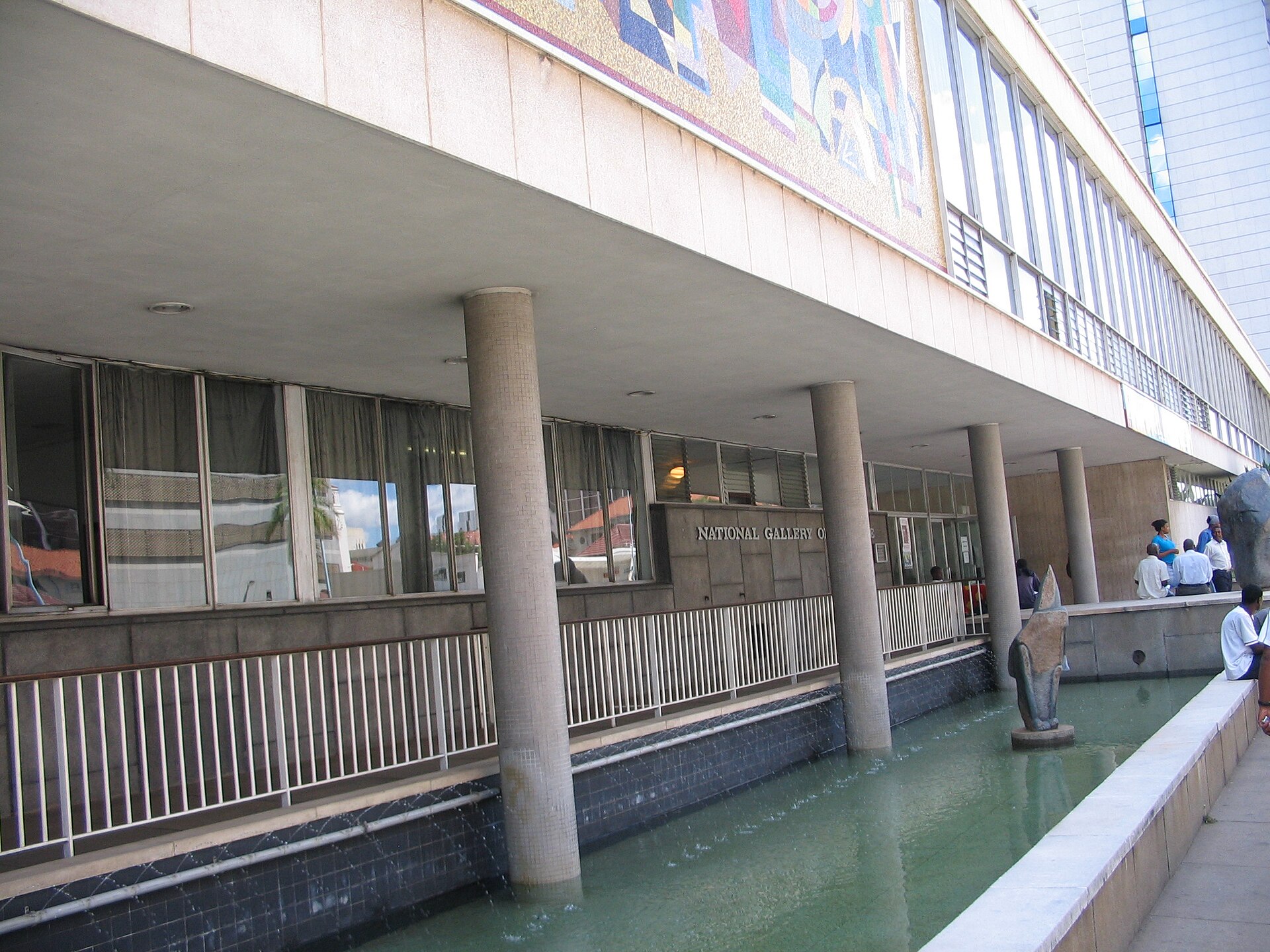
Entrance to the National Gallery of Zimbabwe, photographed in 2007. It does not show the 2026 CIMAM conference.National Gallery of Zimbabwe · CC BY-SA 3.0 · Cropped
In an ART AFRICA interview, Raphael Chikukwa discusses Zimbabwe’s selection to host the 2026 CIMAM Annual Conference. The National Gallery of Zimbabwe director considers how meeting in Africa could strengthen collaboration among museums and bring greater attention to locally developed approaches to leadership and cultural work.
ART AFRICA’s September 2025 report introduced Christine Eyene’s What the Mountain Has Seen at Liverpool’s Exhibition Research Lab. The exhibition connected Lolodorf, Cameroon, with Liverpool through archival material and contemporary art. Works by Yvon Ngassam, Boris Nzebo, Joy Gregory, Shiraz Bayjoo and others approached landscape, botanical histories and memory through film, collage, cyanotype and textiles, with Mount Mbanga as a recurring reference.
In ArtThrob, Nkgopoleng Moloi interviewed Clive Kellner about the Joburg Contemporary Art Foundation’s non-collecting, research-led model. Kellner described free public programming that places Johannesburg artists in dialogue with the wider Global South and builds audiences through exhibitions, publications and talks. The discussion highlighted MADEYOULOOK’s Dinokana in the Structures exhibition, alongside the foundation’s effort to connect local knowledge, architectural history and international artistic exchange.
ART AFRICA described how artists at Johannesburg’s August House transformed donated back issues into Kanti Senzeni, an installation and exhibition associated with Parliament of the Wild. Painting over, cutting and reworking magazine covers allowed the artists to question visibility, erasure and ownership of the historical record. The publisher’s first-person account documented an unusual local collaboration in which an archive became material for artistic dissent rather than simply a source to preserve.
Writing for ArtThrob, Lukho Witbooi considered how the 2025 group exhibition Thresholds at Southern Guild in Cape Town approached relationships between people, materials and land. The review examined works by Amine El Gotaibi, Simphiwe Buthelezi, Patrick Bongoy and others, connecting their different practices to memory, cosmology and environmental histories.
In August 2025, ART AFRICA reported plans for Zohra Opoku’s first museum survey at Zeitz MOCAA in Cape Town. Curated by Beata America and Phokeng Setai, We Proceed in the Footsteps of the Sunlight was scheduled to bring together more than a decade of photography, textiles, print and installation. The announcement connected the Ghanaian-German artist’s work with ancestry and diasporic experience, describing water, breath and ground as recurring themes.
ArtThrob reported that Maseru-based artist Thato Toeba received the 2025 FNB Art Prize. Also a lawyer and social-sciences researcher, Toeba works with photomontage and assemblage to examine identity, history and power. The jury’s account stressed the work’s compositional discipline, thoughtful use of materials and conceptual clarity, recognising a practice rooted in Lesotho.
Writing for C& in July 2025, Imen Zarrouk explored Bao Books, the Tunis bookstore, design studio and publishing project founded by Moez Akkari. The feature described its Moving Forward collaboration with Egypt’s Esmat publishing house, intended to improve regional book circulation through hubs in Tunis and Cairo. Zarrouk connected that infrastructure to artists’ publications by Farah Khelil, Abdullah al Saadi and Yasmine El Meleegy.
Nkgopoleng Moloi’s ArtThrob interview examined the new Standard Bank Art Lab at Nelson Mandela Square through curator Same Mdluli’s ambitions for wider public access. Its inaugural textile exhibition included Gladys Xaba and the Katlehong Community Centre alongside loans from tapestry studios. Moloi weighed the possibilities of encountering historical art in a shopping centre against questions about corporate collecting, colonial commercial histories and who such spaces actually reach.
ArtThrob announced that Gabrielle Goliath, Lebohang Kganye, Sabelo Mlangeni and Lindokuhle Sobekwa would appear at MoMA for the first time in New Photography 2025: Lines of Belonging. The series’ fortieth-anniversary edition connected Johannesburg with Kathmandu, New Orleans and Mexico City. Rather than treating photography as isolated image-making, the exhibition situated personal narratives within community formation and environmental, colonial and structural histories.
Writing in Contemporary And in July 2025, Ann Mbuti reflected on her participation in Mangrove Ecologies, a collaborative residency and research project linking Lamu and Basel. The work brought sound, installation, workshops and community conversations into dialogue with coastal environments. Mbuti questioned how artistic exchange is shaped by unequal resources and how its effects might be understood beyond conventional measures of impact.
Zada Hanmer’s 2025 ArtThrob review explored Daneel Thumbiran’s Brahmacarya at Johannesburg’s Bag Factory. Part of the Young/Unframed programme, the exhibition combined Hindu imagery, city scenes and collage to examine the artist’s layered South African Indian identity. Hanmer considered how wheat-pasted works moved between the visual languages of public space, personal reflection and the gallery.
In a July 2025 ArtThrob review, Emily Freedman examined Aaron Philander’s Nanna’s Kitchen at AVA Gallery. Philander assembled tools, furniture and other inherited or discarded objects into sculptures exploring family histories, domestic labour and coloured identity in South Africa. Freedman read the works as acts of remembering that also reconsider how everyday objects carry cultural knowledge.
Ivorian artist Joana Choumali turns dawn photographs into layered works using embroidery, sheer fabrics and collage. In this Global Voices interview, she traces the move from documentary photography towards an intuitive practice shaped by memory, faith and inner peace. Her Alba’hian series grew from early walks in Abidjan, while her reflections on scale and hand-stitching show how making art can open a dialogue with both herself and her audience.
Jonah Batambuze discussed The Hands of Gods with Stephan Rheeder for ART AFRICA ahead of its 2025 presentation in Wild at Art at Atelier Mondial in Basel. Combining a short film, sculptural installation and participatory elements, the work drew on the artist’s Black Ugandan–South Indian household. Batambuze described everyday gestures, shared meals and the left hand as ways to explore inherited knowledge and the relationship between personal memory and diasporic identity.
C& reported in June 2025 that Emmanuel Aggrey Tieku had won the Ellipse Prize in an edition focused on Ghana’s emerging artists. His practice repurposed second-hand textiles to examine consumption, identity and environmental change. Selected from five finalists, Tieku was awarded production support and an announced presentation at AKAA in Paris, following the finalists’ exhibition at Accra’s Mix Design Hub.