Writing in BUALA, Marta Lança explores how visual artist and performer Mussunda N’zombo’s work informs Paulo Idalécio’s 2025 short film Sabes Quem Eu Sou?. The review connects his screen character to A Metamorfose, a 2018 performance, and to his use of costume, gesture and alter egos. Through a fictional man whose authority is no longer recognised in Luanda, the film extends that artistic investigation into identity and the performance of power.
Writing in ArtReview, Mark Rappolt assesses the sound-led Busan Biennale, Dissident Chorus. His review gives sustained attention to Drexciya and Abu Qadim Haqq’s visual universe and Julien Creuzet’s Caribbean-inflected installation, connecting them through water, memory and Black Atlantic histories. Rappolt questions whether curated rebellion can escape didactic display, while identifying moments of play and sensory intensity. The exhibition spans three Busan venues and closes on 1 November 2026.
Writing for African Arts with Taj, Tajudeen Sowole examined the tension between environmental themes and visual abundance in Godspower Okoro’s Echoes of Extinction. The critic discussed the work’s Ankara-inspired patterns, seated figure and use of light as expressions of identity and memory. While recognising its visual richness, he questioned whether that density weakened its ecological message.
Nana Poulot’s Art Report Africa review highlighted four presentations at AKAA 2026 in Paris. Ernest Breleur’s radiographic collages, Aliou Diack’s plant-based materials, Souleimane Barry’s dense painted vegetation and Maya Inès Touam’s staged photographs offered distinct approaches to bodies, memory and place. The account connected Caribbean, Senegalese, Burkinabè and Algerian-diaspora practices through close readings of individual works.
Reporting from Design Week Lagos for Art Report Africa, Chibuzo Emmanuel examined an exhibition spanning furniture, textiles and visual art alongside a tribute to Demas Nwoko. Discussions involving Mpho Matsipa, Myles Igwebuike, Victor Ekpuk and other practitioners shifted attention from overseas recognition toward local institutions, collecting and preservation. The article situated contemporary design within African histories and the practical structures needed to sustain makers.
In Hyperallergic, Neil Price examines how the Toronto Biennial’s Things Fall Apart connects memory, movement and historical rupture. He highlights Dawoud Bey’s landscapes, Antonio Obá’s participatory installation and Raphaël Barontini’s tribute to Harriet Tubman. While finding individual works compelling, Price questions the exhibition’s cohesion and its assumption of a previously unified world. Allison Glenn curated the biennial, which continues through 20 December 2026.
Writing in ArtReview, Gee Wesley examines Pap Souleye Fall’s exhibition at MIT’s List Visual Arts Center. The Senegalese-American artist combines discarded screens, sculptural scaffolding and illustrated wooden books with the fictional struggle between DEAD PIXEL and THE DATA COLLECTOR. Wesley connects the installation’s recurring peanuts and cowrie shells to West African histories, reading its playful construction as a challenge to digital consumption. The exhibition runs through 29 November 2026.
In ArtReview, Mark Rappolt assesses Ekow Eshun’s British Art Show 10 across Coventry’s galleries. His review discusses how Liz Johnson Artur’s photographs of African-diaspora communities and Ufuoma Essi’s archival video approach collective life through movement, alongside Nnena Kalu’s drawings. Rappolt finds the exhibition’s experiments with identity more compelling when art engages lived experience rather than remaining contained by gallery conventions. The Coventry presentation continues until 10 January 2027.
Writing for ArtReview’s partnership with Salzburger Kunstverein, Cairo-based researcher Hana Elhaddad addresses Ryan Gander in an open letter about his exhibition One Hundred Things Twice. She recounts navigating its objects, entrance and accompanying publication, asking how viewers find meaning when an artwork’s purpose is uncertain. Her essay considers the gap between seeing an object and understanding it, bringing a Cairo-based critical voice into an international conversation about exhibition-making.
Olivier Barlet examines how Jacques Panijel’s Octobre à Paris and Yasmina Adi’s Ici on noie les Algériens approach the repression of Algerian demonstrators in Paris. His review considers testimony, language, reconstruction and archival images. The films feature in an Algerian cinema programme in Paris, while Panijel’s documentary returns to French cinemas on October 21.
In African Arts with Taj, critic Tajudeen Sowole considered John Chukwuemeka Okoye’s I Am Just A Boy paintings as an exploration of expectations placed on young men. He discussed the relationship between finely rendered figures, adolescent experimentation and resistance to prescribed roles. While praising Okoye’s technical control, Sowole questioned whether the close resemblance to photography limited the paintings’ expressive possibilities.
Olivier Barlet reviews a new study of the Cinémathèque Afrique, examining film preservation, circulation and the legacies of French cultural diplomacy. Edited by Farah Clémentine Dramani-Issifou, the volume brings together researchers and practitioners. Barlet, who contributed a chapter himself, argues for stronger connections with African archives and greater attention to cultural sovereignty.
Writing in C& América Latina, Inés Sybille examined how Cherish Menzo and Camilo Mejía use movement, sound and changing stage materials in DARKMATTER. Reflecting on a Barcelona performance she saw in April, the critic connected its slowed gestures and shifting bodily forms with Black diasporic ways of imagining other possibilities. Her October essay treats the performers’ transformation of the stage as integral to the work’s exploration of visibility.
ACP examined an untitled acrylic painting by Congolese artist Misoko Ngusu through the observations of critic John Bongenya. He read the central female figure, blue setting, vegetation and birds as connections between femininity, nature and spirituality. The report focuses on how colour, texture and symbolism shape his interpretation of the work, without identifying a new exhibition or a creation date.
Marta Lança revisits Sara CF de Gouveia’s documentary The Sound of Masks through the performances of Mozambican Mapiko dancer Atanásio Cosme Nyusi. Her BUALA essay considers how choreography, masking and storytelling carry memories that official archives miss, while questioning how cinema represents cultural inheritance and its transmission between generations without freezing a living practice.
Writing in ArtReview, Alexander Harding examines Lyndon Barrois Jr.’s Desert of Promise at Alma Pearl in London. Paintings, collages and sculptural arrangements draw on National Geographic and film references to question the authority of images and systems of classification. Harding finds the work most effective when its material juxtapositions communicate directly, rather than depend on extensive explanation. The exhibition runs through 24 October.
Tajudeen Sowole reviewed Christianah Anuoluwapo Apanisile’s textile-based mixed-media work in African Arts with Taj. Focusing on Stories Beneath the Old Tree and Lessons by the Fire, he explored how drawing and fabric convey exchanges of knowledge between generations. The review praised her handling of figures and restrained colour while questioning the scale of elements in one composition.
Writing for BUALA, Sumaila Jaló reads Sana Na N’Hada’s film Nome as a reflection on Guinea-Bissau’s liberation struggle and the disappointments that followed independence. His review traces how characters’ shared names express solidarity before power divides them. It praises the film’s engagement with collective memory while distinguishing political ideals from their later betrayal.
BUALA·
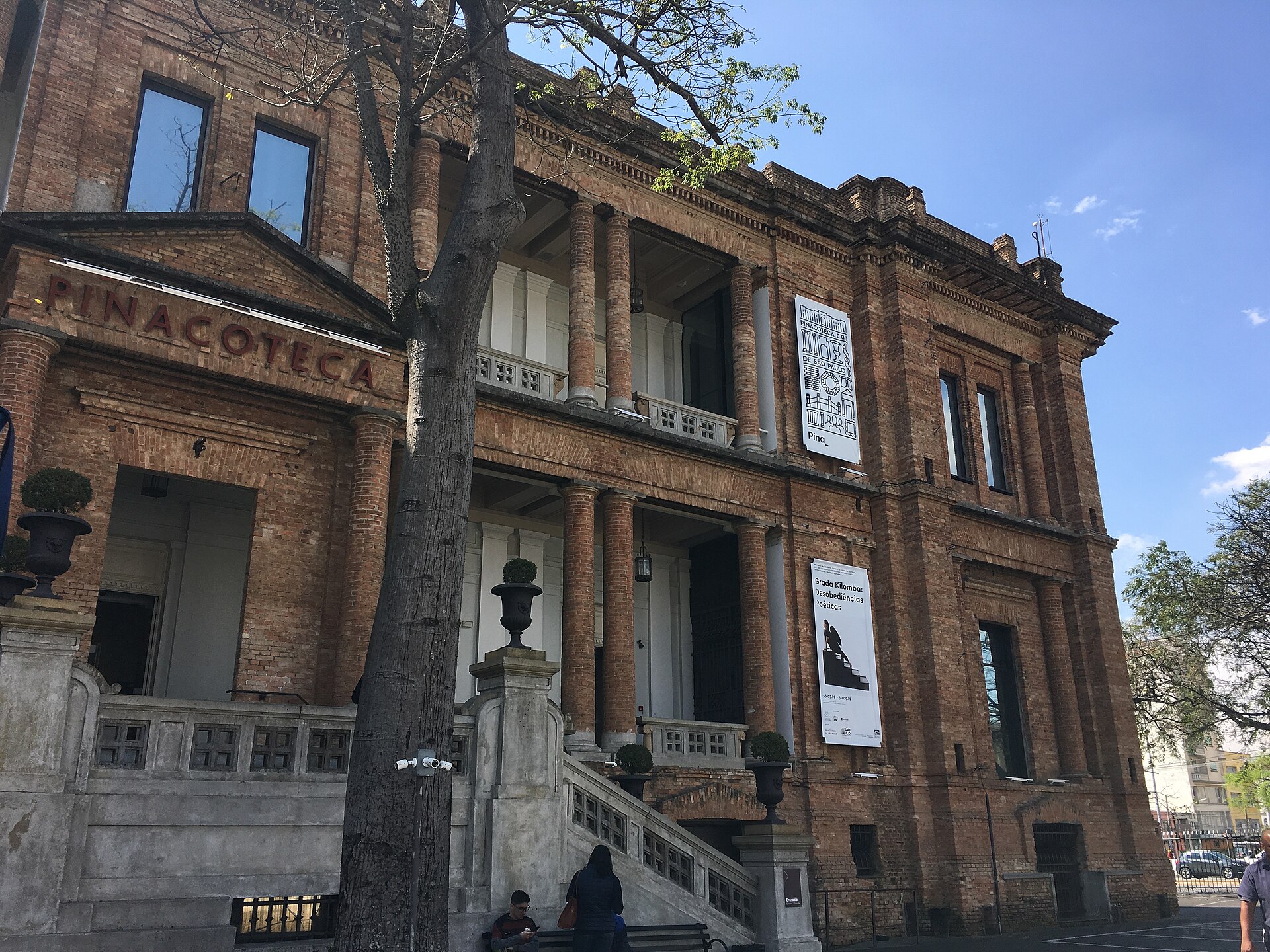
Pinacoteca de São Paulo, photographed in 2019. Paulo Pedro Leal’s 2026 exhibition is not pictured.Leiteligia · CC BY-SA 4.0 · Cropped
Reviewing Paulo Pedro Leal’s exhibition at the Pinacoteca de São Paulo, Mateus Nunes argues for the painter’s place in Brazilian art history. His ArtReview essay examines scenes of violence, religious gathering and everyday life, connecting their formal construction to race, displacement and the neglect of Black painters.
Nigerian artist Jacqueline Suowari’s Art Report Africa account of the 2026 Armory Show centred on works that changed through close observation. Her selections included Dominique Zinkpè’s clustered figures, Desmond Beach’s textile portraits and Austin Uzor’s constructed, weathered materials. The essay connected artistic technique with inherited knowledge, Black representation and memories of Nigeria, showing how material choices carry stories across different practices.