In Hyperallergic, Neil Price examines how the Toronto Biennial’s Things Fall Apart connects memory, movement and historical rupture. He highlights Dawoud Bey’s landscapes, Antonio Obá’s participatory installation and Raphaël Barontini’s tribute to Harriet Tubman. While finding individual works compelling, Price questions the exhibition’s cohesion and its assumption of a previously unified world. Allison Glenn curated the biennial, which continues through 20 December 2026.
Writing in ArtReview, Gee Wesley examines Pap Souleye Fall’s exhibition at MIT’s List Visual Arts Center. The Senegalese-American artist combines discarded screens, sculptural scaffolding and illustrated wooden books with the fictional struggle between DEAD PIXEL and THE DATA COLLECTOR. Wesley connects the installation’s recurring peanuts and cowrie shells to West African histories, reading its playful construction as a challenge to digital consumption. The exhibition runs through 29 November 2026.
In ArtReview, Mark Rappolt assesses Ekow Eshun’s British Art Show 10 across Coventry’s galleries. His review discusses how Liz Johnson Artur’s photographs of African-diaspora communities and Ufuoma Essi’s archival video approach collective life through movement, alongside Nnena Kalu’s drawings. Rappolt finds the exhibition’s experiments with identity more compelling when art engages lived experience rather than remaining contained by gallery conventions. The Coventry presentation continues until 10 January 2027.
A new book brings together more than 170 Cameroonian artists in a survey spanning a century of modern and contemporary art. Shalom Esene reports for Art Report Africa that Ozong Agborsangaya-Fiteu’s Ô Cameroon! combines artworks with essays and conversations to strengthen the documentation of the country’s artistic history. Its London launch took place at Somerset House during 1-54 on 17 October. Further launches are planned, but their dates have not been established.
Turiya Adkins, Timothy Yanick Hunter and Clifford Prince King have been selected for the Studio Museum in Harlem’s 2026–27 residency, Hyperallergic reports. From November 2026 through October 2027, the artists will receive individual studios, material support and professional-development guidance in the museum’s new building. The programme concludes with a group exhibition, continuing the institution’s support for artists of African descent.
A Tanga BD gathering at Planète J Socimat in Kinshasa is scheduled for 25 October, ACP reports. Organisers plan comics reading, drawing and activities around traditional objects to encourage young audiences to explore art and heritage. Barly Baruti describes the initiative as an accessible route into reading, with Hallain Paluku and Rodriguez Muladika expected to guide participants’ first steps in comics.
Maputo Fast Forward’s tenth-anniversary festival runs from 23 October to 1 November 2026 at JFS Tower in Mozambique’s capital. ART AFRICA reports that Artificial Realities: The Infinite Mirror brings exhibitions, discussions and workshops together around technology and cultural knowledge. Installations and projects by Russel Hlongwane, Dilayla Romeo, Zayaan Khan, Malik Afegbua and Adilson De Oliveira explore territory, memory and image-making.
In an ART AFRICA interview with Suzette Bell-Roberts, curator Fadzai Veronica Muchemwa discusses Second Nature | Manyonga, Zimbabwe’s presentation at the 2026 Venice Biennale. Work by Franklyn Dzingai, Gideon Gomo, Pardon Mapondera, Eva Raath and Felix Shumba connects material processes with memory and change. Muchemwa questions celebratory accounts of resilience, describing adaptation as uneven rather than automatically liberating.
Anastasia Pather and curator Chepape Makgato discuss Mother Tongue at the William Humphreys Art Gallery in an ART AFRICA interview with Suzette Bell-Roberts. Pather describes finger-painting as a way to explore memory, belonging and identity. Her first solo museum exhibition is presented alongside works by women printmakers from the gallery’s collection and remains on view in Kimberley, South Africa, until 26 November 2026.
In an ART AFRICA interview with Suzette Bell-Roberts, Ranti Bam discusses the five Ifa Ile Oja – Black Ifa sculptures presented at the Arsenale in the 2026 Venice Biennale. She describes a physical, intuitive approach to clay, considering memory, vulnerability and spiritual connection. Rather than prescribing a single interpretation, Bam leaves viewers room to find their own relationships with the forms and their surroundings.
Contemporary And editor-in-chief Ethel-Ruth Tawe traces the platform’s development across publishing, education, archives and artist commissions. Writing for C&, she uses the Kongo cosmogram to connect its magazines, Nairobi hub, mobile reading room and other programmes. Her essay introduces a series examining how these interrelated projects support artistic exchange and keep knowledge from Africa and its diasporas in circulation.
In an Africans Column interview with Sophie Campos, artist and cultural organiser John Cox discussed the institutions and relationships sustaining Bahamian art. He described FUZE as a platform for Caribbean and African artistic exchange, while reflecting on barriers such as shipping costs and limited local collecting markets. Cox also considered the tension between his own studio practice and building opportunities for others, placing community and long-term collaboration at the centre of his approach.
Writing for ArtReview’s partnership with Salzburger Kunstverein, Cairo-based researcher Hana Elhaddad addresses Ryan Gander in an open letter about his exhibition One Hundred Things Twice. She recounts navigating its objects, entrance and accompanying publication, asking how viewers find meaning when an artwork’s purpose is uncertain. Her essay considers the gap between seeing an object and understanding it, bringing a Cairo-based critical voice into an international conversation about exhibition-making.
The National Arts Festival in Makhanda is recruiting an artistic director on a renewable five-year contract, ART AFRICA reports. The festival’s official vacancy notice confirms that the role spans curatorial direction, visual arts and other disciplines, commissioning, the Fringe and artist development. Applicants will need programming and leadership experience, including budget management and African and international partnerships. ART AFRICA lists 30 October 2026 as the deadline; applications must use the festival’s official online form.
Three works by British-Nigerian artist Okiki Akinfe have been acquired for Abbot Hall in Kendal through the inaugural Dasha Shenkman Focus Fund. Shalom Esene’s Art Report Africa profile examines the painter’s practice following the selection at Frieze London. The acquisition comprises a painting, a lightbox work and a preparatory drawing, placing several aspects of her work in a public collection. The fund supports an acquisition, rather than an unrestricted cash award to the artist.
Hyperallergic’s October 20 newsletter highlights the launch of Mohammad Omer Khalil: Common Ground at New York’s Center for Art, Research and Alliances on October 25. The organisers describe the book, edited by Amina Ahmed and Jenna Hamed, as a collection of essays, studio material and archival records tracing the Sudanese artist’s career between Sudan, Italy and New York. The event will combine readings with conversation involving Khalil and contributors.
Hyperallergic·
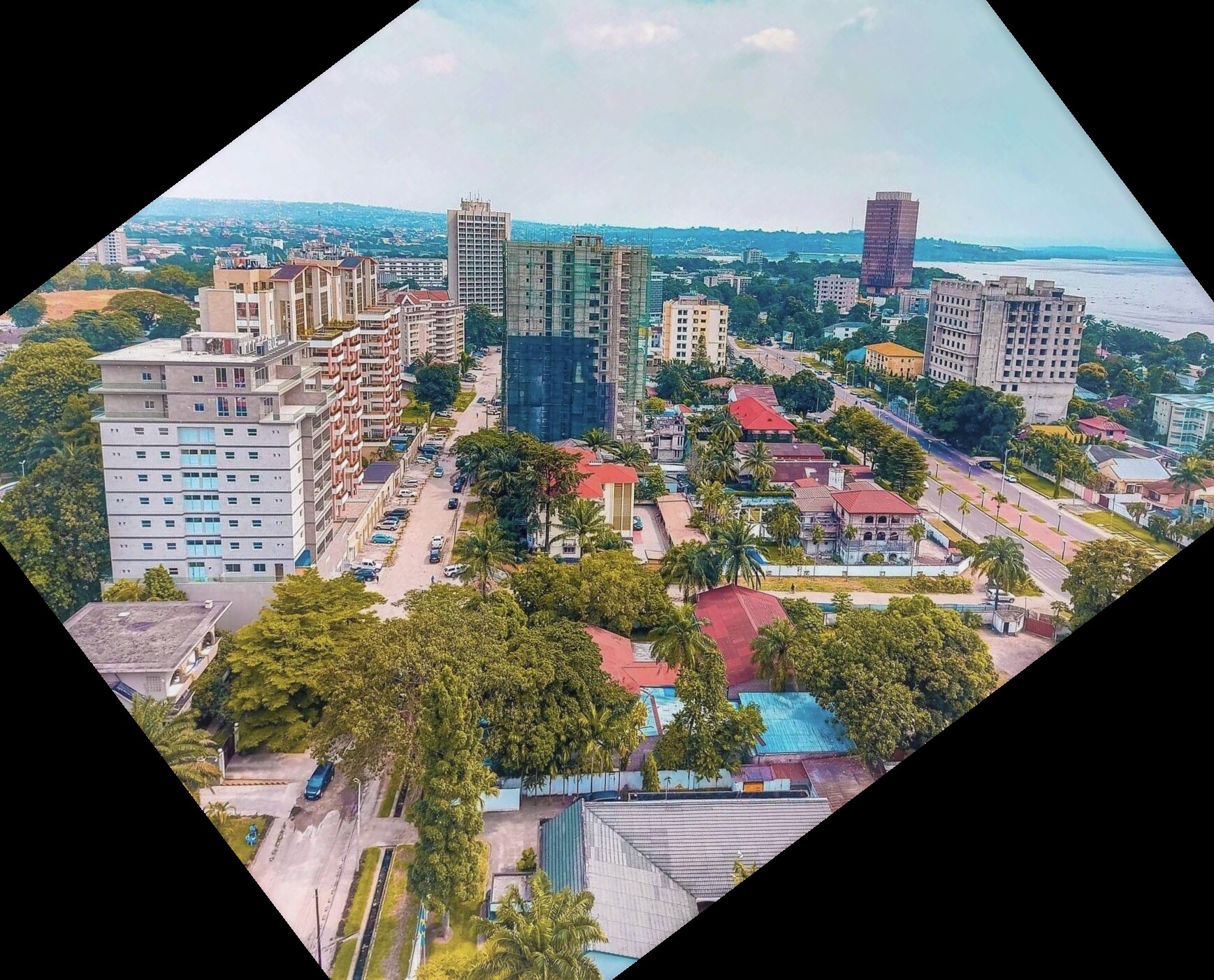
Contextual aerial view of Kinshasa, not a competition entry. Photograph by EdwinAlden.1995; existing rotation by Respublik.EdwinAlden.1995 · CC BY-SA 4.0
Kinshasa’s Best Talent Visuel competition will use drawing, photography, graphic design and video to explore the capital under the theme “Kin la Belle”. Organiser Platini Ndaka told ACP that the November 2 edition aims to foreground cultural heritage, local talent and everyday initiatives, encouraging artists to tell more varied stories about the city.
In an ART AFRICA interview published on 20 October, researcher Jane Freedman reflects on a Johannesburg exhibition in which young people used photography and podcasts to examine migration and belonging. Participants selected and arranged their own work, retaining control over how their stories were shared. The exhibition opened at Bag Factory Artists’ Studios on 13 June 2026; the new interview considers its participatory approach rather than announcing a forthcoming show.
Olivier Barlet examines how Jacques Panijel’s Octobre à Paris and Yasmina Adi’s Ici on noie les Algériens approach the repression of Algerian demonstrators in Paris. His review considers testimony, language, reconstruction and archival images. The films feature in an Algerian cinema programme in Paris, while Panijel’s documentary returns to French cinemas on October 21.
In an ART AFRICA interview, Anina Major discusses translating Bahamian palm-plaiting traditions into ceramic sculpture for The Sacred Mangrove at Pérez Art Museum Miami. Drawing on skills inherited from her grandmother, the installation connects family memory, migration and Caribbean ecology. Major describes bottle trees as references to African-diaspora spiritual practices and questions the separation of craft from fine art. The interview considers how inherited techniques change across generations and places.