In an interview with Daniela Mayer, Afro-Brazilian artist Rosana Paulino explains how her artist’s book ¿História Natural? challenges colonial representations of Brazil and Black people. The 2016 work combines printmaking, altered expedition photographs and stitching on paper and fabric. Presented by the Vera List Center in New York, her exhibition places that critique of archival images alongside her natural-pigment drawings of figures within seeds.
For National Heroes Day, Jamaica's National Gallery highlighted Michael ‘FreeStylee’ Thompson's 2010 digital poster Rebel from its collection. The work depicts Paul Bogle, leader of the 1865 Morant Bay Rebellion. The museum's October 19 post connects the image to the holiday's remembrance of Jamaica's national heroes.
National Gallery of Jamaica·
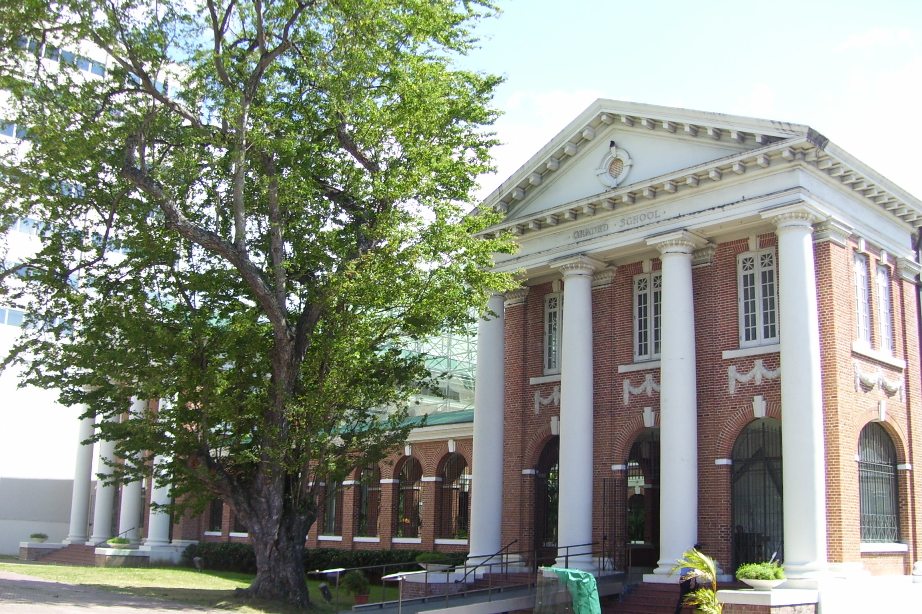
Museo de Arte Contemporáneo de Puerto Rico, March 2009—not a view of the current exhibition. Photograph: Carlo Giovannetti (Thief12 at English Wikipedia), CC BY-SA 3.0, via Wikimedia Commons.Thief12 at English Wikipedia · CC BY-SA 3.0
Afro-Caribbean artist Awilda Sterling-Duprey is among the participants in Diasporican Abstraction: Identities Beyond Representation at the Museo de Arte Contemporáneo de Puerto Rico. The museum’s sponsored announcement describes a survey of more than sixty artists exploring migration, memory and abstraction across Puerto Rico and its diaspora. Sterling-Duprey’s inclusion connects the show to an artistic practice that the Joan Mitchell Foundation describes as combining abstract painting and Caribbean religious dance traditions.
Two bronze sculptures by Alfred Liyolo at the Congolese press agency’s Kinshasa headquarters are receiving renewed attention after a visit by his daughter, Myoto Liyolo. ACP’s account recalls their installation in 1975 and considers their place in the agency’s history, connecting the sculptor’s monumental practice with the preservation of institutional cultural heritage.
The Democratic Republic of Congo’s visual artists’ union and Belgium’s Stanley’s Auctions have announced talks towards a strategic partnership. According to a communiqué reported by ACP, discussions will address artwork traceability, authentication, contracts and artists’ rights. The proposed framework also seeks to protect artists’ market standing and strengthen safeguards for Congolese cultural heritage.
Kunstinstituut Melly in Rotterdam announced a survey of South African artist Moshekwa Langa spanning work made between 1995 and 2026. Curated by Gabi Ngcobo and Kabelo Malatsie, You Will Find Us in the Best Places will bring together nearly 120 works across drawing, collage, photography, video and installation. ART AFRICA describes a presentation organized around recurring memories, places and questions of belonging rather than a strict chronology.
ART AFRICA·
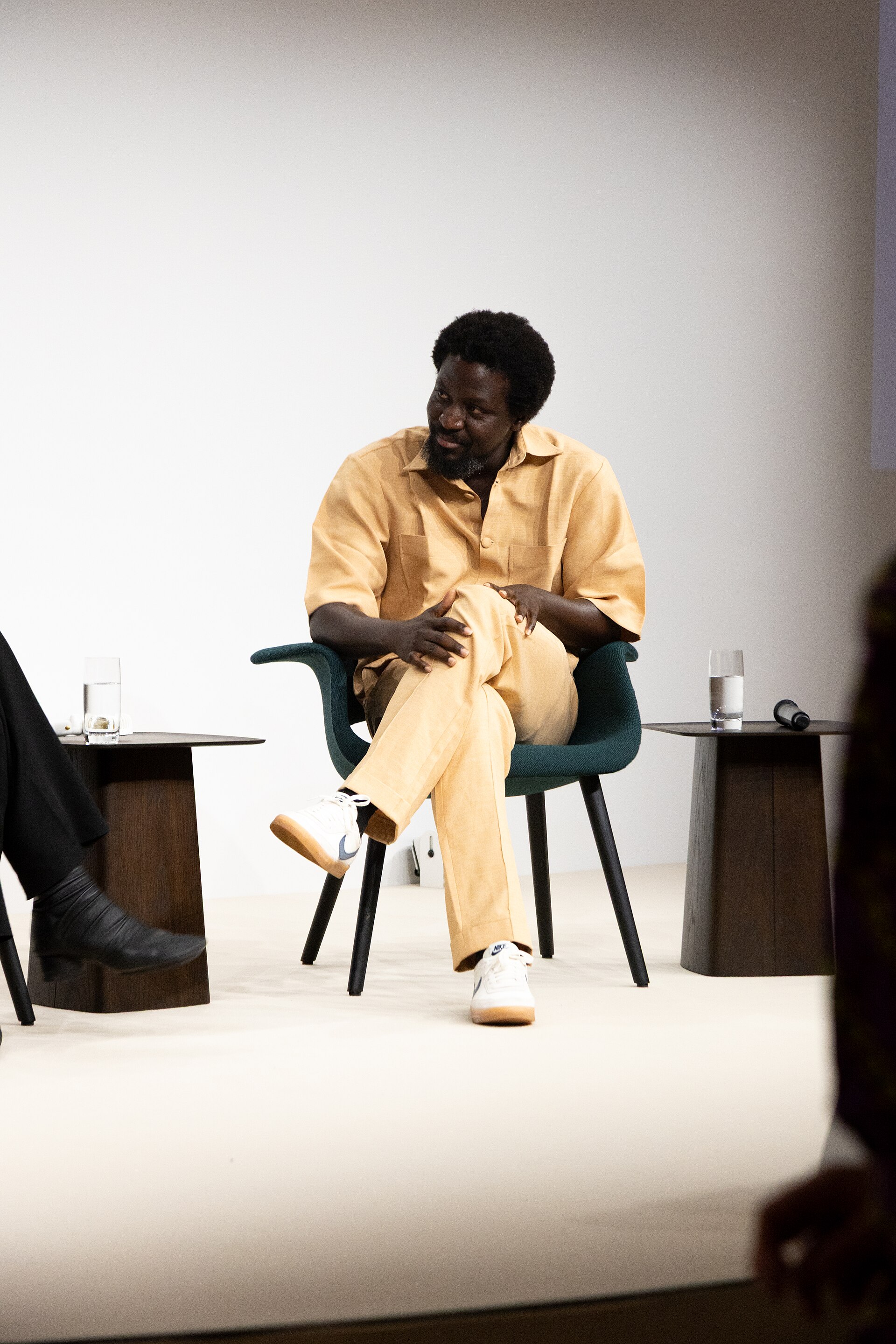
Ibrahim Mahama at Art Basel in Basel, Switzerland, on 20 June 2025. Contextual artist portrait, not the Paris exhibition. Photo: Bea Phi, CC BY-SA 4.0.Bea Phi · CC BY-SA 4.0
ART AFRICA reports that Ibrahim Mahama’s The Harvest Season at Fondation Cartier in Paris will connect installations and archival materials with contributions from nine artists and collectives. Drawing on Ghana’s colonial and postcolonial histories, the exhibition examines labour, industrial heritage and collective memory. Contributors include James Barnor, Dorothy Akpene Amenuke, Gideon Appah, Zohra Opoku and the Congolese collective CATPC, extending the collaborative approach of Mahama’s cultural institutions in Tamale.
ART AFRICA describes Sonja John’s Balikbayan installation at the Katonah Museum of Art as an exploration of migration and Caribbean family memory. Collage, stencils and light connect architectural shapes with plant imagery, drawing on relationships between New York, Jamaica, Trinidad and Tobago, and the Philippines. Visitors can also take part in mixed-media activities and a collaborative light installation. The exhibition runs until 24 January 2027.
Intermittent Islands at New York’s Katonah Museum of Art brings together Belkis Ayón, Yanira Collado, Marielle Plaisir and Lisa C Soto. ART AFRICA describes an exhibition connecting Caribbean displacement and cultural memory through printmaking, textiles, found materials and installation. Ayón draws on Afro-Cuban spiritual traditions, while Plaisir examines race and power; their works connect personal experience with wider histories of identity and belonging.
The Photographers’ Gallery in London presents Colour Years, an exhibition of Sanlé Sory’s colour photographs from Burkina Faso. ART AFRICA reports that the Burkinabé photographer began experimenting with colour in the mid-1980s at his Volta Photo studio in Bobo-Dioulasso. Curated by Taous Dahmani, the presentation includes restored prints and Volta Jazz record covers, examining portraiture, self-representation and everyday life after independence.
ART AFRICA reports on Torkwase Dyson’s first solo exhibition in Austria, at Kunsthaus Bregenz. Monumental sculptures, paintings, animation and sound examine how Black communities create spaces of autonomy within environments shaped by slavery and colonialism. Dyson’s large black sculptural forms and abstract compositions turn the museum itself into part of her inquiry into movement and belonging. The exhibition is reported on view until 24 January 2027.
ART AFRICA reports that Ayana Evans’s first museum survey at the Contemporary Art Museum St. Louis brings together performance documentation, videos, archival material and new work. Curated by Dean Daderko, the exhibition explores how race, gender and class influence visibility and self-expression. It includes her long-running Operation Catsuit project and an interactive installation inviting visitors onto a red carpet. The exhibition is reported on view until 7 February 2027.
Egyptian artist Rafik Greiss’s The City and the City at Berlin’s KW Institute for Contemporary Art combines a newly commissioned film with black-and-white photographs. ART AFRICA describes figures waiting in desert landscapes, accompanied by a score from musician 7038634357. Curated by Emma Enderby and Liberty Adrien, the exhibition considers anticipation, perception and the instability of memory through images that resist a fixed historical or geographical reading.
Africans Column explored Emily Alice Mitchell’s presentation with DēpART at FUZE Caribbean Art Fair in Nassau. Working across photography, collage and sculpture, the British-Caribbean artist brought family archives into dialogue with migration, memory and belonging. The feature examined how materials including wood, steel, beads and shells carry personal histories, and how sculptural gates incorporating Sankofa connect her Trinidadian family context with wider African diasporic traditions.
G.A.S. Foundation and the Yinka Shonibare Foundation are developing new ways to make their collections accessible online through a partnership with Archival Consciousness. Announced on 18 October, the collaboration uses Biblio-Graph to connect archiving and publishing. A new G.A.S. Publish platform will support Re:assemblages, with an Archive Futures essay series planned for January 2027. The foundation says the work will also preserve material from its African Arts Libraries network.
In an October 17 interview with ACP, Congolese visual artist Raphaëlla Anakasala outlined Fleuve coloré, a women’s art workshop planned in Kinshasa for October 30. She intended it to welcome participants without painting or drawing experience. The river would offer inspiration rather than a compulsory subject, allowing each participant to explore her own understanding of womanhood through an individual artwork.
In African Arts with Taj, critic Tajudeen Sowole considered John Chukwuemeka Okoye’s I Am Just A Boy paintings as an exploration of expectations placed on young men. He discussed the relationship between finely rendered figures, adolescent experimentation and resistance to prescribed roles. While praising Okoye’s technical control, Sowole questioned whether the close resemblance to photography limited the paintings’ expressive possibilities.
Art Report Africa reported on Yinka Ilori’s Chairman exhibition at the Walter Sickert Community Centre in Islington, where the British-Nigerian artist grew up. Drawing on Tobi Alexandra Falade’s interview and reporting, the article connected around thirty chair works with personal histories and Ilori’s first monograph. It examined his choice of a community setting beyond Frieze Week’s main venues and his ambitions for wider access.
South African artist Unathi Mkonto has won the Nicoletta Fiorucci Foundation Prize for his Goodman Gallery presentation at Frieze London, reports Shalom Esene in Art Report Africa. Nominated by Yinka Shonibare for the fair’s Artist-to-Artist section, Mkonto will share the £10,000 prize with the Yinka Shonibare Foundation. The award also includes a commission to be shown at the foundation in London in 2027; precise exhibition dates have not been announced.
Culture Congo reported on the ninth Lubumbashi Biennale, whose theme Manger la terre connects resource extraction with memory, territory and cultural knowledge. Curator Sorana Munsya outlined the exhibition’s concerns, while participating artists described projects addressing transformed landscapes, extractive promises and medicinal plants. Organised around Picha and partner venues across the city, the biennale was scheduled from 15 October to 15 November 2026.