After seeing William Kentridge’s More Sweetly Play the Dance at the Milwaukee Art Museum, Debra Brehmer reflects on the procession of figures moving across its eight screens. Her essay relates the South African artist’s images of burdens and confinement to a nearby protest against US immigration policies. The connection is the critic’s interpretation, extending into a self-examination of privilege, segregation and the limits of solidarity.
In April 2018, the National Gallery of Jamaica announced the return of John Dunkley: Neither Day nor Night after its presentation at Pérez Art Museum Miami. Scheduled for April 29 through July 29, the Kingston exhibition brought together 34 paintings and nine sculptures by the self-taught Jamaican artist. Nicole Smythe-Johnson was to oversee the local installation with the gallery’s curatorial team, alongside an accompanying monograph.
Diana Sette reviews The Ecstasy of St. Kara, an exhibition of Kara Walker’s drawings at the Cleveland Museum of Art. Developed after a period working in Rome, the works bring religious imagery into contact with histories of enslavement, racial violence and Black self-determination in the United States. Sette reads their recurring figures and scenes as an examination of martyrdom, oppressive narratives and the possibility of resisting inherited violence.
Adrian Piper received the best-artist Golden Lion at the 2015 Venice Biennale for The Probable Trust Registry: The Rules of the Game #1–3. C& reported the award during Okwui Enwezor’s exhibition All the World’s Futures. The Biennale’s official record confirms the winning work and identifies the ceremony as 9 May 2015; the project placed questions of trust and personal responsibility within a participatory conceptual artwork.
ArtReview’s Siona Wilson considers Afterword, Kara Walker’s return to the imagery and reception of her 2014 sugar installation A Subtlety. Preparatory drawings, sculptural remnants and films extend the project’s questions about looking. Wilson focuses on An Audience, assembled from footage of visitors during the installation’s final hour, and the contrast between emotional encounters with the work and the habitual production of photographs and selfies.
Hrag Vartanian examines Kara Walker’s A Subtlety before its public opening at Brooklyn’s former Domino Sugar Factory. A monumental white sphinx and smaller sugar figures connect the installation to the industry’s reliance on enslaved labor. His review also considers the tensions surrounding the site’s planned redevelopment, asking how a tribute to exploited workers sits within the changing economics and cultural memory of Williamsburg.
Reviewing Gravity and Grace at the Brooklyn Museum, Maeve Gately examines El Anatsui’s large metal hangings and their capacity to change with each installation. The exhibition combined twelve monumental works with pieces in other materials. Her account connects the Ghanaian artist’s use of Nigerian liquor-bottle caps to West African histories of trade and consumption, while emphasizing the sculptures’ shifting surfaces and spatial presence.
The National Gallery of Jamaica’s November 2012 announcement set out a biennial combining invited artists with a juried section open to Jamaican artists and artists living in Jamaica. Scheduled from December 9 to March 9, 2013, it also included tributes to recent Musgrave medal recipients Omari S. Ra, Bryan McFarlane and Ebony G. Patterson. Participants were eligible for the Aaron Matalon Award and consideration for acquisition awards.
Rachel Wetzler reviews The Global Africa Project at New York’s Museum of Arts and Design, which brought together artists and makers connected to Africa and its diasporas. She praises the exhibition’s thematic pairing of textiles, furniture, photography and other forms for challenging artistic hierarchies. The review also questions its treatment of corporate branding and argues that its strongest achievement is resisting a single definition of African creativity.
In December 2010, the National Gallery of Jamaica announced a tribute exhibition to painter and printmaker Albert Huie, who had died earlier that year. Scheduled to open on December 30, the presentation drew from the national collection and covered work from the late 1930s to the late 1990s. The accompanying public gathering was to include poetry, music and participation by his daughter, Christine Huie-Roy.
Reporting on William Kentridge’s lecture at the New York Studio School, Hyperallergic traces how experiments in painting, acting and filmmaking informed the South African artist’s practice. Kentridge describes erasing and redrawing charcoal images on the same sheet, allowing their remaining traces to shape his animations. The account connects this open-ended process with his staging of Shostakovich’s The Nose and his MoMA retrospective.
Marking its thirty-fifth anniversary in December 2009, the National Gallery of Jamaica reported that its collection had grown to more than 1,700 works. The Kingston institution had recently completed new Edna Manley galleries as part of a wider renewal of its permanent displays. Its anniversary statement outlined a collection spanning Taíno art to modern Jamaican practice, alongside exhibitions, educational programmes and plans to refurbish further galleries.
Alexandre Mensah reports on the Musée Dapper’s reopening in Paris after a two-year closure. He describes Alain Moatti’s redesign, developed with director Christiane Falgayrettes-Leveau, and the enlarged museum’s combination of collection galleries, a performance hall and space for contemporary photography and painting.
Africultures·
Edouard Duval-Carrié in 2014. Contextual portrait; not a photograph of the 2000 exhibition.Kenneth C. Zirkel · CC BY-SA 3.0
Alexandre Mensah and Jacques Binet review Haiti, anges et démons at the Halle Saint Pierre in Paris. Their account highlights the variety of Haitian painting, including work by Edouard Duval-Carrié, Frantz Lamothe, Mario Benjamin and Elodie Barthélémy, and considers how the exhibition challenges narrow categories applied to these artists.
Jacques Binet profiles Rajae Faddi Salam, Martine Nze and Mam Këk, considering their different routes into painting and approaches to colour, form and personal experience. The original Africultures article offers a period account of three individual practices connected to Morocco and Gabon, rather than a single school or shared style.
In an interview with Jacques Binet, gallery owner Antoinette Jean describes how literature led her to Haitian painting. She discusses Saint Soleil, spiritual imagery and questions of attribution, while stressing the dignity and individuality of the artists whose work she presents.
The Museum of Modern Art’s March 1971 announcement presents Richard Hunt’s first major museum retrospective, bringing together fifty sculptures alongside drawings and prints. The release traces his movement from found metal toward open, linear forms and larger architectural structures. Studies for public commissions show an expanding scale of practice. The document records an exhibition planned for New York before a further presentation in Chicago, where Hunt lived.
By AFROSCOPE Daily·Source: The Museum of Modern Art·
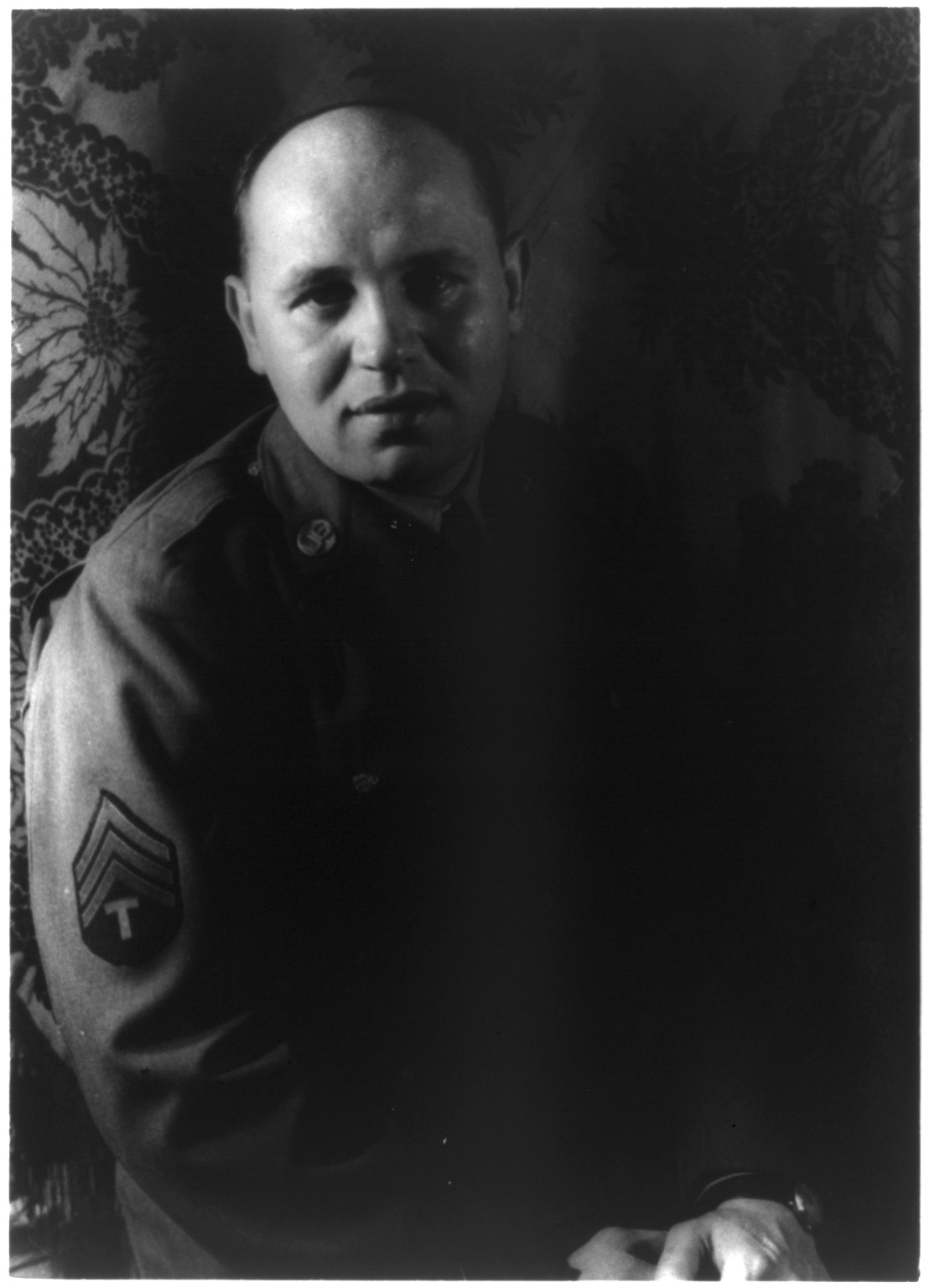
Romare Bearden in 1944, photographed by Carl Van Vechten. Library of Congress, Prints & Photographs Division, Carl Van Vechten Collection, LC-USZ62-42507. Contextual portrait; not a photograph of the 1971 exhibition.Carl Van Vechten · Public domain
The Museum of Modern Art’s advance fact sheet presents Romare Bearden’s collage as an exploration of everyday Black life, from music and worship to family meals. Guest director Carroll Greene assembled fifty-six works, including enlarged collages and The Block, an eighteen-foot mural accompanied by sound. The historical announcement also records planned presentations in Washington and Berkeley.
By AFROSCOPE Daily·Source: The Museum of Modern Art·
The Museum of Modern Art’s announcement records a Harlem park mural developed from paintings by seven young artists. Betty Blayton Taylor selected their designs through the Children’s Art Carnival, and twenty youngsters worked with three teachers to paint the ninety-foot wall. The account describes paid youth participation and a mural intended to serve as a setting for outdoor plays. MoMA’s archive catalogues the document to 1971; an exact issue date is not established.
By AFROSCOPE Daily·Source: The Museum of Modern Art·
The Museum of Modern Art’s 1952 recent-acquisitions checklist includes Wilson Bigaud’s Murder in the Jungle and Enguerrand Gourgue’s Magic Table, both acquired through the Inter-American Fund. Their presence within an international display documents the museum’s engagement with modern Haitian painting. This is a contemporary acquisition record, rather than a later account of the artists’ reputations.
By AFROSCOPE Daily·Source: The Museum of Modern Art·