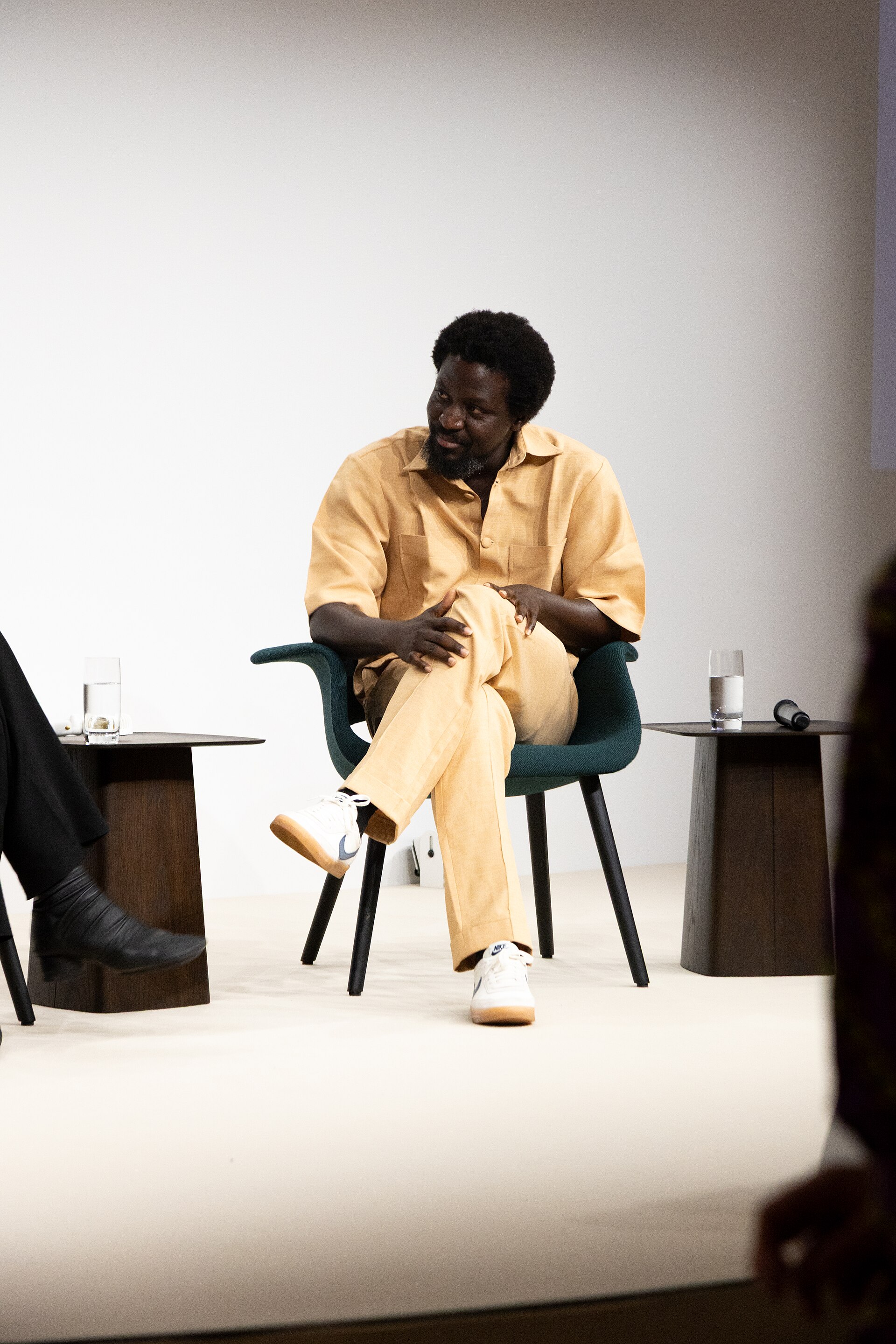
ArtReview placed Ibrahim Mahama first in its 2025 Power 100, citing both his artistic practice and his support for cultural infrastructure. The magazine highlighted the Ghanaian artist’s investment in Red Clay Studio, the Savannah Centre for Contemporary Art and Nkrumah Volini in Tamale.
In an October 2025 contribution to C&, Maktaba Room described its month-long reading space at Düsseldorf’s ThisThat Gallery in August 2025, without specifying exact dates. Initiated by Cate Lartey and Donja Nasseri, the project brought together art, design and printed matter by African, Asian and diasporic authors. Its selections included Grace Wales Bonner’s MoMA publication and Project a Black Planet, treating books as resources for creative exchange rather than fixed displays.
ArtReview reported that Tadáskía won the 2025 K21 Global Art Award and that the museum’s friends acquired her site-specific installation. The Brazilian artist combined wall drawing, a bilingual poem and sculptures made from organic materials, including taboa reeds. The award recognised a practice concerned with transformation and Afro-trans cosmologies, while placing a materially experimental work at Kunstsammlung Nordrhein-Westfalen through a permanent loan from its friends’ association.
ART AFRICA’s September 2025 report introduced Christine Eyene’s What the Mountain Has Seen at Liverpool’s Exhibition Research Lab. The exhibition connected Lolodorf, Cameroon, with Liverpool through archival material and contemporary art. Works by Yvon Ngassam, Boris Nzebo, Joy Gregory, Shiraz Bayjoo and others approached landscape, botanical histories and memory through film, collage, cyanotype and textiles, with Mount Mbanga as a recurring reference.
ART AFRICA described how artists at Johannesburg’s August House transformed donated back issues into Kanti Senzeni, an installation and exhibition associated with Parliament of the Wild. Painting over, cutting and reworking magazine covers allowed the artists to question visibility, erasure and ownership of the historical record. The publisher’s first-person account documented an unusual local collaboration in which an archive became material for artistic dissent rather than simply a source to preserve.
In August 2025, ART AFRICA reported plans for Zohra Opoku’s first museum survey at Zeitz MOCAA in Cape Town. Curated by Beata America and Phokeng Setai, We Proceed in the Footsteps of the Sunlight was scheduled to bring together more than a decade of photography, textiles, print and installation. The announcement connected the Ghanaian-German artist’s work with ancestry and diasporic experience, describing water, breath and ground as recurring themes.
ArtThrob reported that Maseru-based artist Thato Toeba received the 2025 FNB Art Prize. Also a lawyer and social-sciences researcher, Toeba works with photomontage and assemblage to examine identity, history and power. The jury’s account stressed the work’s compositional discipline, thoughtful use of materials and conceptual clarity, recognising a practice rooted in Lesotho.
Writing for C& in July 2025, Imen Zarrouk explored Bao Books, the Tunis bookstore, design studio and publishing project founded by Moez Akkari. The feature described its Moving Forward collaboration with Egypt’s Esmat publishing house, intended to improve regional book circulation through hubs in Tunis and Cairo. Zarrouk connected that infrastructure to artists’ publications by Farah Khelil, Abdullah al Saadi and Yasmine El Meleegy.
ArtThrob announced that Gabrielle Goliath, Lebohang Kganye, Sabelo Mlangeni and Lindokuhle Sobekwa would appear at MoMA for the first time in New Photography 2025: Lines of Belonging. The series’ fortieth-anniversary edition connected Johannesburg with Kathmandu, New Orleans and Mexico City. Rather than treating photography as isolated image-making, the exhibition situated personal narratives within community formation and environmental, colonial and structural histories.
C& reported in June 2025 that Emmanuel Aggrey Tieku had won the Ellipse Prize in an edition focused on Ghana’s emerging artists. His practice repurposed second-hand textiles to examine consumption, identity and environmental change. Selected from five finalists, Tieku was awarded production support and an announced presentation at AKAA in Paris, following the finalists’ exhibition at Accra’s Mix Design Hub.
ART AFRICA published a gallery announcement about Tizta Berhanu’s Agape at Addis Fine Art in Addis Ababa. The exhibition explored enduring love through layered oil paintings whose overlapping figures retained individual expressions even in intimate groupings. The article connected Berhanu’s translucent colour and swirling brushwork to her use of models, photographs and found imagery, offering an account of how the Ethiopian painter constructs scenes of care, vulnerability and complicated human connection.
C& reported that Nigerian artist Modupeola Fadugba won the 2025 Norval Sovereign African Art Prize for Portrait of an Artist at Ease. The award included funding, a planned Cape Town solo exhibition and a London residency. DuduBloom More received the FAMM Women’s Prize for Contending With Control, while the finalists’ exhibition brought painting, printmaking and textile practices into the Norval Foundation’s programme.
Anna Adima’s January 2025 C& feature examined the exchanges shaping Kampala’s visual-art community. She followed artists Seyi Adelekun, Birungi Kawooya and Henry Robinson through residencies, installations and photographic projects connected to 32 Degrees East, KLA ART and local galleries. The report highlighted collaborative learning and resourcefulness while distinguishing the opportunities available to visiting diaspora artists from the constraints facing locally based practitioners.
Isa Farfan’s Hyperallergic report examined Kelli Morgan’s launch of the Black Artists Archive in Detroit in July 2024. Encounters with artist and educator Marian Stephens helped turn an exhibition research project into a wider effort to preserve overlooked artistic lineages. Alongside archives held in homes and studios, Morgan envisaged future curatorial and residency programmes supporting living communities outside traditional institutional structures.
ART AFRICA documented the New York presentation of Points of Resonance at The Africa Center, bringing together twelve photographers working across Africa and its diaspora. The exhibition connected approaches to memory, migration and colonial histories through artists including Fatoumata Diabaté, Lebohang Kganye, Sammy Baloji and Maheder Haileselassie. Its move from an initial Egyptian presentation in 2023 added a transatlantic chapter to that conversation.
Sarah Rose Sharp reported in Hyperallergic on Kinship: The Legacy of Gallery 7 at the Museum of Contemporary Art Detroit. Curated by Abel González Fernández, the exhibition revisited the artist-run space Charles McGee established in 1969 and its commitment to Black abstraction. By pairing foundational participants with later artists, including Elizabeth Youngblood and Gilda Snowden, the show treated that history as an ongoing artistic inheritance.
ART AFRICA published the curatorial announcement of thirty artists selected for La Panafricaine, the central group exhibition of the fourteenth Bamako photography biennial. Under the theme Kuma, or the Word, the edition proposed a dialogue between images, speech and memory. Its selection ranged across the continent and diaspora, including Héla Ammar, Nuno Silas, Zara Julius, Maheder Haileselassie Tadese and Jeannette Ehlers.
Published by ArtThrob from the catalogue for Igshaan Adams’s Weerhoud exhibition at The Hepworth Wakefield, Nkgopoleng Moloi’s essay examined movement as a source for material and spiritual exploration. It connected Adams’s work with dancers to his textile practice, questions of trauma and the body’s cultural inscriptions. The account located these experiments within community collaboration and Sufi thought, extending discussion of the artist beyond decorative readings of weaving.
Maya Pontone reported for Hyperallergic on a family-held portrait newly displayed at the Baltimore Museum of Art. Attributed to James Alexander Simpson and thought to depict Mary Ann Tritt Cassell, the 1839 painting may have been commissioned by her mother, Henrietta Steptoe, who had been enslaved. The reporting traced family provenance and curatorial research while preserving uncertainty around the sitter and commission.
ART AFRICA reported on Passengers in Transit, a Venice Biennale collateral exhibition organised by the Centre for Contemporary Art, Lagos. April Bey, Christa David, Euridice Zaituna Kala, Joana Choumali and Thandiwe Muriu explored belonging through interdisciplinary practices and archives. The curatorial framework connected Black women’s representation with cross-cultural identity, drawing on the right to opacity rather than asking difference to become easily legible.