Folasade Ologundudu discusses how Nigerian modernist publications and contemporary art can reshape the histories we inherit. Her 1-54 London project combined an exhibition with critical writing labs, inviting participants to contribute to a living archive. The interview makes a case for sustained support for African criticism, publishing and research, rather than visibility alone.
The 16th Dakar Biennale will take place from 19 November to 19 December 2026, with Morad Montazami as artistic director. An official announcement from Biennale de Dakar, dated 24 September 2026 and posted on 13 October, details 75 artistic proposals: 54 for the international exhibition and 21 for the design section. The theme, “(Anti)fragility,” explores repair, care and responses to disruption. Faouzi Laatiris is the Grand Témoin, alongside a Carte blanche for Serigne Mbaye Camara.
Biennale de Dakar has named artist Amadou Kane Sy as curator of Senegal’s pavilion, titled Re-enchanting the World. According to the organiser, the presentation will bring together varied forms of contemporary Senegalese artistic practice, connecting artists’ local contexts with international cultural exchange. The announcement outlines the pavilion’s curatorial purpose but does not identify participating artists or specify exhibition dates.
Marta Lança revisits Sara CF de Gouveia’s documentary The Sound of Masks through the performances of Mozambican Mapiko dancer Atanásio Cosme Nyusi. Her BUALA essay considers how choreography, masking and storytelling carry memories that official archives miss, while questioning how cinema represents cultural inheritance and its transmission between generations without freezing a living practice.
Biennale de Dakar has included Laila Gohar in its design selection, identifying her with Egypt and the United States. Its artist profile describes a New York-based practice combining food, design and performance, with edible materials shaped into sculptural compositions. The organiser connects her work to sensory experience, memory and cultural exchange, without specifying the work she will present in Dakar.
Biennale de Dakar has announced Trajectories and Heritage, an exhibition of Senegal’s state art collection curated by Kalidou Kassé. The organiser says the presentation examines the country’s visual-art history through major institutional acquisitions. It is being developed by the Directorate of Cultural Heritage, the biennale’s general secretariat and the National Art Gallery. The announcement does not provide an exhibition timetable.
Biennale de Dakar has announced the Democratic Republic of the Congo as guest country of honour for its 16th edition, with artist Steve Bandoma curating its presentation. The organiser places the Congolese pavilion alongside its international exhibition and design section. Its national-pavilion programme gives participating countries space to present their contemporary art scenes through their own curatorial choices.
Africans Column’s guide to 1-54 London selected 20 women artists across generations, including Bertina Lopes, Baya, Esther Mahlangu, Thandiwe Muriu and Theresah Ankomah. Its account connected painting, photography, ceramics and textiles with questions of cultural memory and representation, while discussing the fair’s African Modernism spotlight. Published ahead of the 15–18 October fair at Somerset House, the selection reflected the announced programme rather than a definitive ranking or a post-event assessment.
During an ACP gallery visit, Congolese artist Serge Homboyoka Kadima, known as Makadi, discussed Malamba, a painting drawing on the ritual dancer of the same name in Bashilele culture. The artist described the figure’s ancestral significance and the costumes associated with its performance. His broader practice combines painting, recovered materials and textile sculpture to revisit the community’s mythic and ritual imagery.
APS’s cultural calendar places Dak’Art’s sixteenth edition from 19 November to 19 December, with the former Palais de Justice hosting its international exhibition and national pavilions. The agency also lists a Saint-Louis cinema and photography salon for 26–28 November and the inauguration of Musée Griot-tes in Tambacounda on 3–5 December, including a group exhibition and discussions. Together, the planned events extend the visual-art programme beyond Dakar.
Writing in ArtReview, Alexander Harding examines Lyndon Barrois Jr.’s Desert of Promise at Alma Pearl in London. Paintings, collages and sculptural arrangements draw on National Geographic and film references to question the authority of images and systems of classification. Harding finds the work most effective when its material juxtapositions communicate directly, rather than depend on extensive explanation. The exhibition runs through 24 October.
An exhibition at Dakar’s Museum of Black Civilisations revealed visual-art practices among Senegalese police officers during the first Police culturelle event. APS describes photographs by Ousseynou Faye, paintings and collage, an electronic-waste installation by Dieylani, and Betty Tendeng’s reused-straw picture frames. The presentation formed part of a broader programme also including music and sport.
African Arts with Taj reported ArtLab Gallery’s plans for Fragments, a presentation of small-format works by six Nigerian artists in Ikeja, Lagos. Scheduled for 17 October–3 November, the exhibition brings together practices concerned with memory, identity and everyday life. ArtLab’s Timi Balogun described miniature works as an invitation to slow, close viewing, setting the exhibition’s intimate scale against the prominence of large-format art.
Black Liquid Art Gallery in Rome is presenting Nirveda Alleck’s Spread Over the Ocean Bed from 10 October to 5 December 2026. Curated by Antonella Pisilli, the exhibition pairs the Mauritian artist’s video Insular Variations II – Arise with seven paintings made between 2017 and 2024. C& and the gallery frame the presentation around submerged histories and identity; the gallery describes it as Alleck’s first Italian solo show.
Amoako Boafo’s The Home I Have Never Had opened at Mariane Ibrahim in Paris on 19 October 2026 and is scheduled to run through 19 December. The gallery describes an interior-like installation combining recent portraits, including paintings with embroidery, with works dating to 2016. C& lists the exhibition as an exploration of home and belonging through people close to the Ghanaian artist.
Contemporary And (C&)·
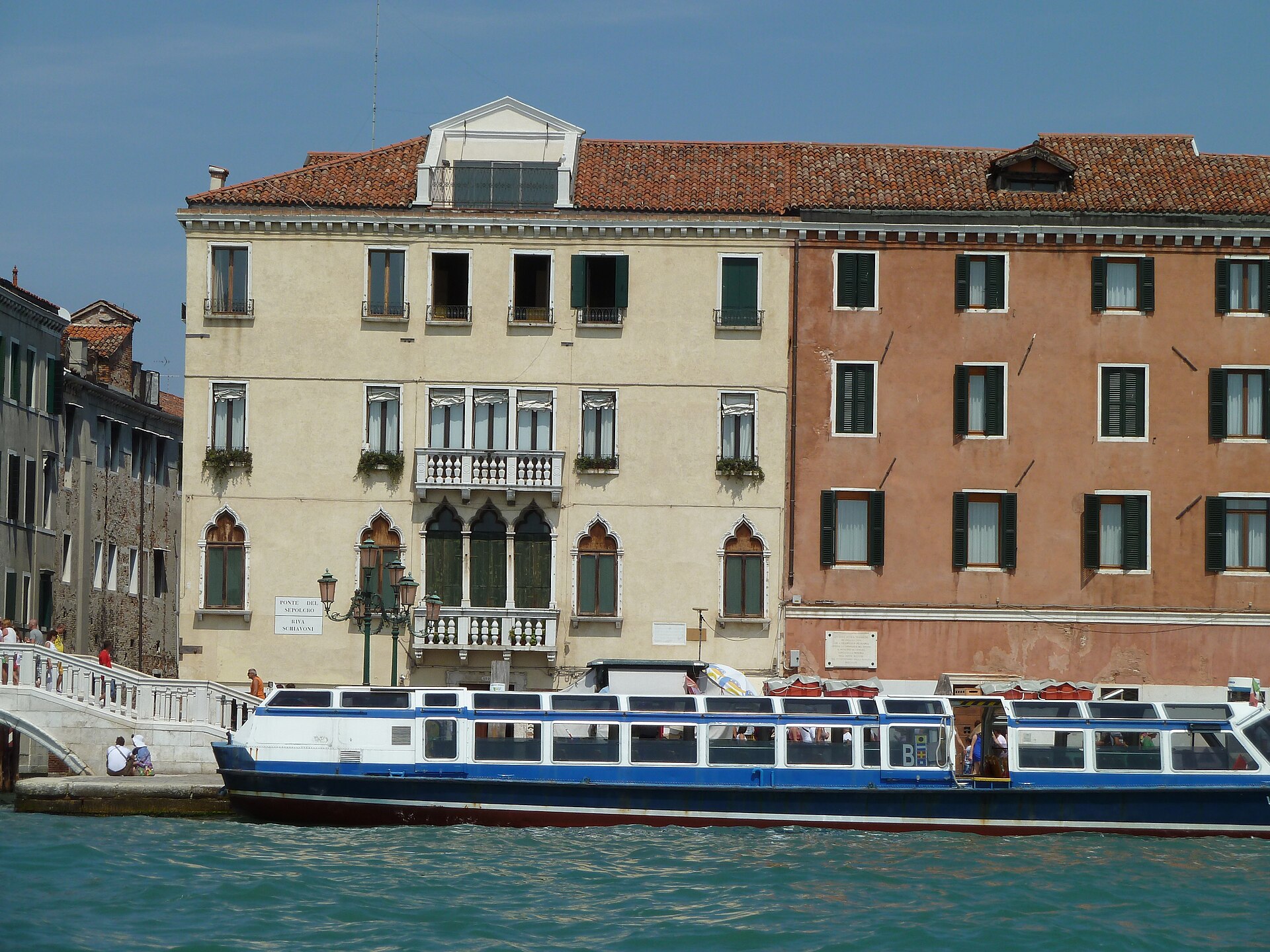
Palazzo Navagero on the Riva degli Schiavoni, photographed in 2012. Caroline Gueye’s WURUS installation is not pictured.Abxbay · CC BY-SA 3.0 · Cropped
In an ART AFRICA interview, Senegalese artist Caroline Gueye discusses WURUS, her Venice Biennale pavilion curated by Massamba Mbaye. The installation transforms Palazzo Navagero through architecture, sculpture and changing viewpoints, using the idea of gold to examine how perception shapes the value people assign to things.
Selassie Atadika brings cocoa farming into the gallery through portraits, field recordings, agricultural materials and a brass pod cast by Emmanuel Fosu. In an interview about Commodity / Couture at 1-54 London, she explains how the installation connects craft and agricultural knowledge while questioning whose labour receives recognition and economic value.
Léon Radegonde discusses a practice built around hessian, wood, rust and deliberately aged materials in an interview about Restan Lepase at 1-54 London. Presented by DēpART, the project connects his work with writing, research and sound, offering a view of Seychelles beyond tourism imagery and reflecting on the country’s developing contemporary-art institutions.