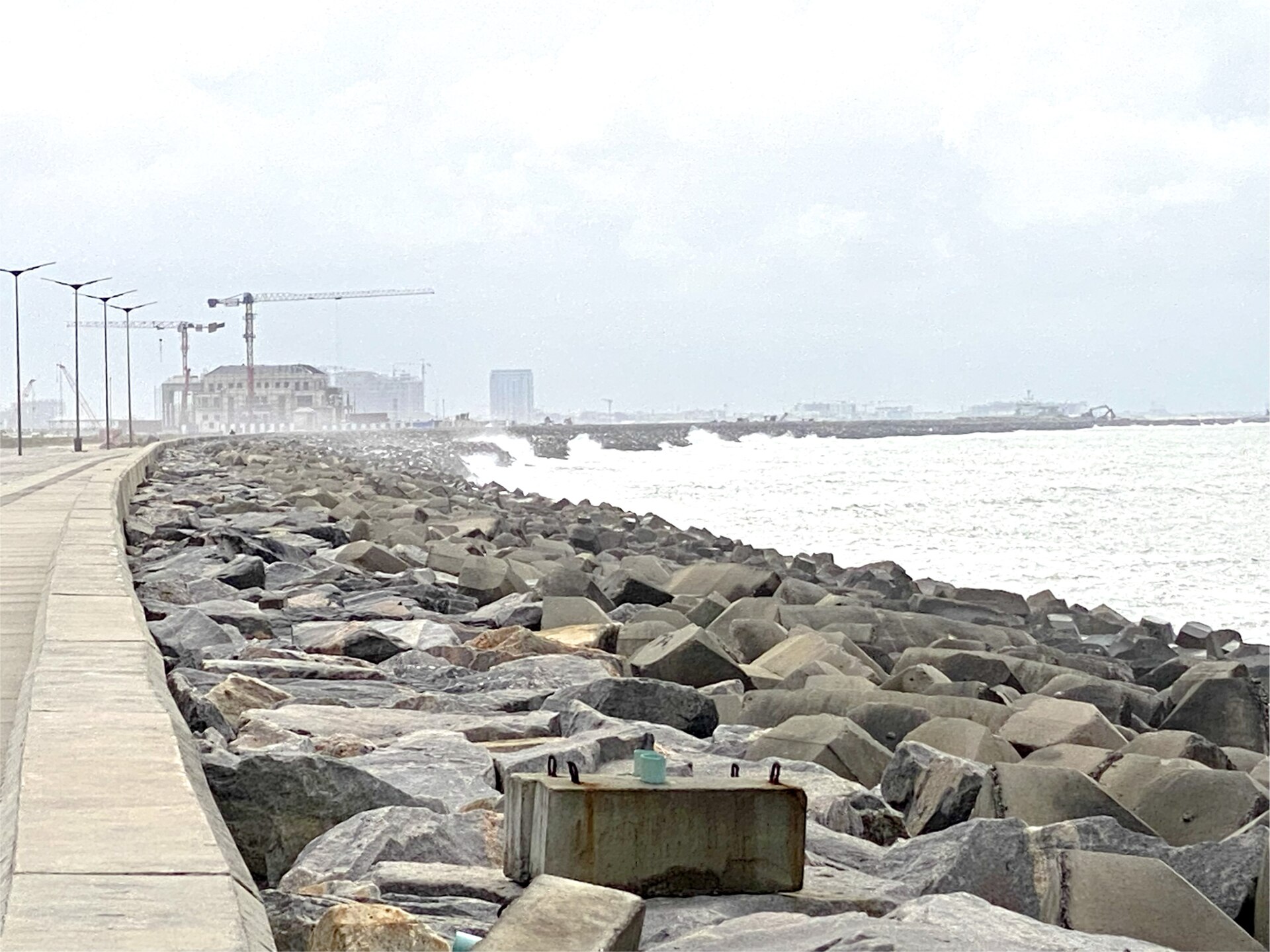
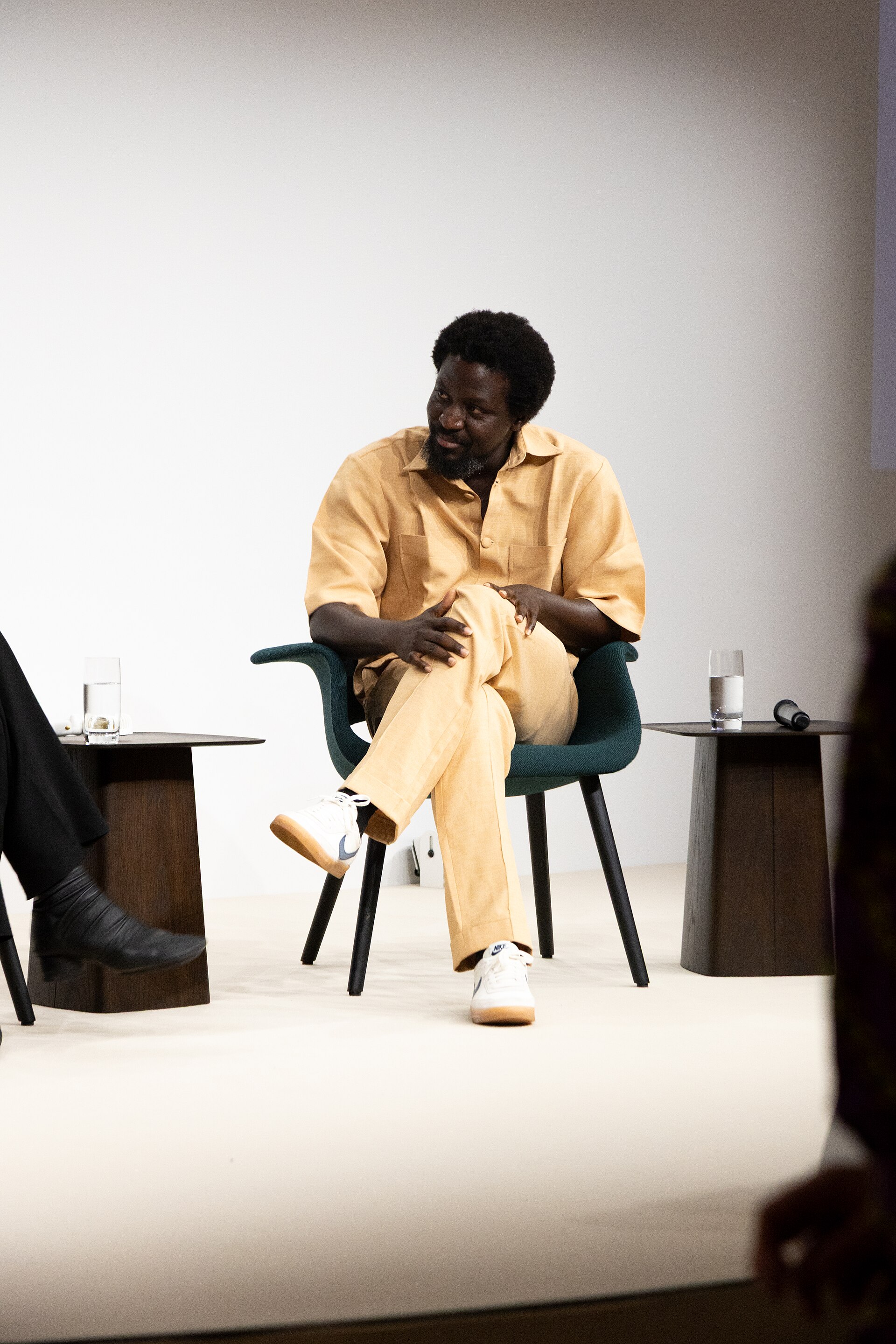
ArtReview’s November exhibition guide highlights the Lagos Biennial alongside presentations by Salah Elmur in Dubai and Atong Atem in Melbourne. The Lagos edition, running 14 November–6 December, brings together 18 artists and collectives and launches a permanent pavilion for the Àkéte Collection. Elmur’s survey connects painting with family photographs and Sudanese modernism, while Atem’s presentation explores African studio portraiture, family memory and Dinka cultural traditions across more than 65 works.
Contemporary And editor-in-chief Ethel-Ruth Tawe traces the platform’s development across publishing, education, archives and artist commissions. Writing for C&, she uses the Kongo cosmogram to connect its magazines, Nairobi hub, mobile reading room and other programmes. Her essay introduces a series examining how these interrelated projects support artistic exchange and keep knowledge from Africa and its diasporas in circulation.
Olivier Barlet reviews a new study of the Cinémathèque Afrique, examining film preservation, circulation and the legacies of French cultural diplomacy. Edited by Farah Clémentine Dramani-Issifou, the volume brings together researchers and practitioners. Barlet, who contributed a chapter himself, argues for stronger connections with African archives and greater attention to cultural sovereignty.
Nancy Dantas discusses West Wind, an exhibition bringing African modernists into conversation across national borders. Works by artists including Kofi Antubam, Gerard Sekoto, Bertina Lopes and Baya frame an exploration of independence, migration and cultural exchange. Her interview emphasises archival research and the relationships that complicate a single, linear account of African art history.
Congolese comics artist Barly Baruti told ACP that the Dakar Biennale could help advance BD Safari, a proposed network linking Kinshasa, Dakar and Tétouan. He outlined ambitions to circulate works, share training and build connections between comics markets across the continent. Baruti also discussed bringing questions of memory, resistance and cultural self-determination into his Dakar contribution. The report described plans and aspirations, not an already operational cross-border network.
Art Report Africa’s September 2026 exhibition roundup paired criticism from Lagos, Abuja and Paris. Sabo Kpade examined vulnerable architectural surfaces and bodily landscapes in Groundwork; Rejoice Anodo considered Dotun Popoola’s reclaimed-metal sculpture; and Nana Poulot discussed Kerry James Marshall’s treatment of Black life within history painting. Together, the accounts followed how materials and representation could carry memories beyond familiar readings of their subjects.
Theophilus Imani examines how four African institutions bring alternative approaches to learning into the Venice Biennale. Reading installations by blaxTARLINES, RAW Material Company, G.A.S. Foundation and Nairobi Contemporary Art Institute together, his essay connects artistic practice with archives, community and reciprocal knowledge, asking how these networks can endure beyond a temporary international exhibition.
Art Report Africa’s September 2026 roundup considered four exhibitions in Paris and Lagos through space, memory and materials. Reviews of Sungi Mlengeya and Ladji Diaby explored spare painted settings and reused domestic objects, while accounts of Crosscurrents and Affinities and The Weight of Traces examined relationships between Nigerian artists. The writing emphasised formal differences and material experimentation rather than treating the shows as interchangeable expressions of identity.
Art Report Africa surveyed September 2026 exhibitions across Lagos, Paris and Stockholm through the themes of memory, belonging and material history. The writers considered CCA Lagos’s treatment of grief, the craft-led Mémoire Matérielle, Emma Prempeh’s layered paintings and Ndidi Dike’s installations about extraction and value. Their account distinguishes firsthand viewing from a reading of official installation photographs.
A Lussas documentary seminar brought together films exploring resistance, colonial memory and the politics of representation. Olivier Barlet’s account follows a programme curated by Raquel Schefer, including work connected to Mozambique and Guinea-Bissau. It considers how archives, experimental forms and collective filmmaking can challenge established ways of seeing rather than simply illustrate political arguments.
Olivier Barlet surveys the young sub-Saharan African documentary programme at Lussas, following films that connect personal experience with wider histories. His account moves from colonial archives and extraction to contemporary streets and rural communities, considering how observation, performance and autobiographical approaches reshape the representation of place, memory and everyday life across the continent.
A S+T+ARTS residency cohort explores artificial intelligence through artistic practices grounded in African contexts. C& highlights Mahoutondji Kinmagbo’s interactive memory tablet, Chipo Mapondera’s water-focused installation and Evans Akanyijuka’s living photographic archive. Together, the projects shift attention from technology as a neutral tool towards the communities and inherited knowledge that shape its use.
Gopalen Parthiben Chellapermal discusses Nous sommes tous des migrants in a FESPACO conversation published by Africultures. The Mauritian filmmaker describes building the documentary from family photographs, his father’s travel diary and encounters with Mauritian families in Britain. His account considers how personal archives and independent filmmaking can open questions about identity, migration and belonging.
C& presents a digital archive documenting the S+T+ARTS Afropean Intelligence programme across five African countries. Curated by Céline Delatte, its nine-chapter reader brings artistic projects into conversation with research, podcasts and shared reflections. The resource extends work on memory, ecological justice and technological narratives beyond the residencies that generated it.
Contemporary And (C&)·
Ibrahim Mahama at Art Basel in 2025. This contextual portrait is not a photograph of his 2026 installation.Bea Phi · CC BY-SA 4.0
Africans Column surveys African and diasporic artists across Art Basel’s 2026 gallery booths, installations and public programme. The overview moves from Ibrahim Mahama’s work in Münsterplatz to presentations involving El Anatsui, Tunisian artists and historical figures, describing a range of practices rather than a single regional style or market category.
Africans Column·
Touria El Glaoui, founder of 1-54, on 1 October 2021. Contextual portrait, not a photograph of the 2026 New York fair. Photo: Editvipcontent / Wikimedia Commons / CC BY-SA 4.0.Editvipcontent · CC BY-SA 4.0
Africans Column considers 1-54 New York as an ecosystem linking galleries, artists, collectors and institutions rather than a market alone. Its review of the 2026 edition emphasises diaspora connections, sustained scholarship and the partnerships surrounding the fair, asking how international attention can develop into lasting support for African and diasporic practices.
Africans Column uses Frieze New York to examine the different ways cultural recognition and market value develop. Contrasting El Anatsui’s institutional history with Southern Guild’s expanding presence, the analysis argues that galleries, museums, archives and criticism sustain careers over time. It cautions against treating a single sale price as a measure of artistic achievement.
Caleb Oheneba-Takyi examines African participation in Art Dubai’s 2026 edition, focusing on Galerie Atiss Dakar, GVCC, Efie Gallery and artist Yaw Owusu. The essay recognises their contributions while arguing for broader representation, placing gallery participation within a larger discussion about access, cultural exchange and the structures that connect African art with international audiences.
ART AFRICA documented the New York presentation of Points of Resonance at The Africa Center, bringing together twelve photographers working across Africa and its diaspora. The exhibition connected approaches to memory, migration and colonial histories through artists including Fatoumata Diabaté, Lebohang Kganye, Sammy Baloji and Maheder Haileselassie. Its move from an initial Egyptian presentation in 2023 added a transatlantic chapter to that conversation.
ArtReview reported the artist list and framework for the 35th Ljubljana Biennale of Graphic Arts, led by Ibrahim Mahama. From the void came gifts of the cosmos connected post-independence Ghana with former Yugoslavia through Kwame Nkrumah’s ideas and histories of non-alignment. Exit Frame Collective’s public programme drew on the Akan concept of council, positioning printmaking and contemporary art as means of building cultural relationships.