In a May 2025 C& interview with Joshua Segun-Lean, curator Favour Ritaro described developing Archives and Memories at CCA Lagos while working remotely. Research into Bisi Silva’s curatorial archive shaped the exhibition, alongside collaboration with Nigerian women artists and the centre’s team. Ritaro discussed trust, peer critique and careful attention to process as ways to sustain curatorial relationships across distance.
In an ART AFRICA interview, architect Glenn DeRoche described his collaboration with Amoako Boafo for I Do Not Come to You by Chance at Gagosian in London. A timber pavilion evoked the gathering place of Boafo’s childhood courtyard in Accra, while Nkyinkyim combined painting with Ghana-made woven and wooden elements. DeRoche explained how these interventions made community and memory part of the exhibition’s physical experience rather than simply providing a backdrop.
Nolan Stevens reviewed Usha Seejarim’s Unfolding Servitude at Southern Guild in Cape Town for ArtThrob in April 2025. The exhibition repurposed clothes pegs, serving trays and ironing soleplates into sculptural forms. Stevens linked these material transformations to the artist’s examination of gendered expectations, domestic work and the often-unrecognised labour of care.
ART AFRICA published a gallery announcement about Tizta Berhanu’s Agape at Addis Fine Art in Addis Ababa. The exhibition explored enduring love through layered oil paintings whose overlapping figures retained individual expressions even in intimate groupings. The article connected Berhanu’s translucent colour and swirling brushwork to her use of models, photographs and found imagery, offering an account of how the Ethiopian painter constructs scenes of care, vulnerability and complicated human connection.
C& reported that Nigerian artist Modupeola Fadugba won the 2025 Norval Sovereign African Art Prize for Portrait of an Artist at Ease. The award included funding, a planned Cape Town solo exhibition and a London residency. DuduBloom More received the FAMM Women’s Prize for Contending With Control, while the finalists’ exhibition brought painting, printmaking and textile practices into the Norval Foundation’s programme.
Larissa de Souza spoke to ART AFRICA about Faith Charm, her 2025 exhibition at Simões de Assis in São Paulo. The paintings connected memories of women in her family with experiences in Angola and Afro-Brazilian cultural traditions. Embroidery, beads, tiles and other domestic materials extended the figurative images into textured assemblages. De Souza described this material experimentation as a way to explore ancestry, oral transmission and the experiences of women across the African diaspora.
Anna Adima’s January 2025 C& feature examined the exchanges shaping Kampala’s visual-art community. She followed artists Seyi Adelekun, Birungi Kawooya and Henry Robinson through residencies, installations and photographic projects connected to 32 Degrees East, KLA ART and local galleries. The report highlighted collaborative learning and resourcefulness while distinguishing the opportunities available to visiting diaspora artists from the constraints facing locally based practitioners.
In its December 2024 announcement, Zeitz MOCAA named Otobong Nkanga as the recipient of its 2025 Honorary Award for Artistic Excellence. The museum highlighted her research-led work across textiles, sculpture, performance and other media, connecting bodies, land and resources. The announcement situates that recognition within the institution’s support for contemporary African and diasporic art; its gala fundraising invitations are now historical.
Alexis Peskine builds portraits from nails and gold leaf, drawing on Afro-Brazilian heritage, family craftsmanship and African spiritual references. Speaking to Global Voices, the Paris-born artist explains how a technique developed during his studies became a way to explore the African diaspora. The interview also follows his shift towards healing and nature in Forest Figures, the body of work shown at London’s October Gallery in 2024.
Zeitz MOCAA’s 2024 announcement introduced Simone Leigh, Stephanie Thomas, Jo-Ann Strauss and Emma Menell as new members of its Global Council. The museum described the group’s role in advocacy, fundraising and strengthening connections with African creative communities. The appointments offer a historical view of how the institution assembled artistic and philanthropic support for its exhibitions and education work, rather than a verified account of its current membership.
Alexandra M. Thomas’s Hyperallergic review examined the Brooklyn Museum’s Elizabeth Catlett retrospective through the artist’s commitments to Black and Mexican liberation. Prints, sculpture and public works connected her representations of women’s labour to her participation in Mexico’s Taller de Gráfica Popular. Thomas emphasised the transnational exchanges and community relationships that shaped Catlett’s practice, treating political organising as integral to her artistic achievement.
Debra Brehmer’s Hyperallergic review of Nordic Utopia? at the Chazen Museum examined Black American artists who worked in Scandinavia. Paintings and objects associated with William H. Johnson, Herbert Gentry, Ronald Burns and Howard Smith complicated familiar accounts centred on Paris. Brehmer described the creative room afforded by migration while noting that the exhibition did not equate life abroad with an uncomplicated escape from racism.
Hyperallergic·
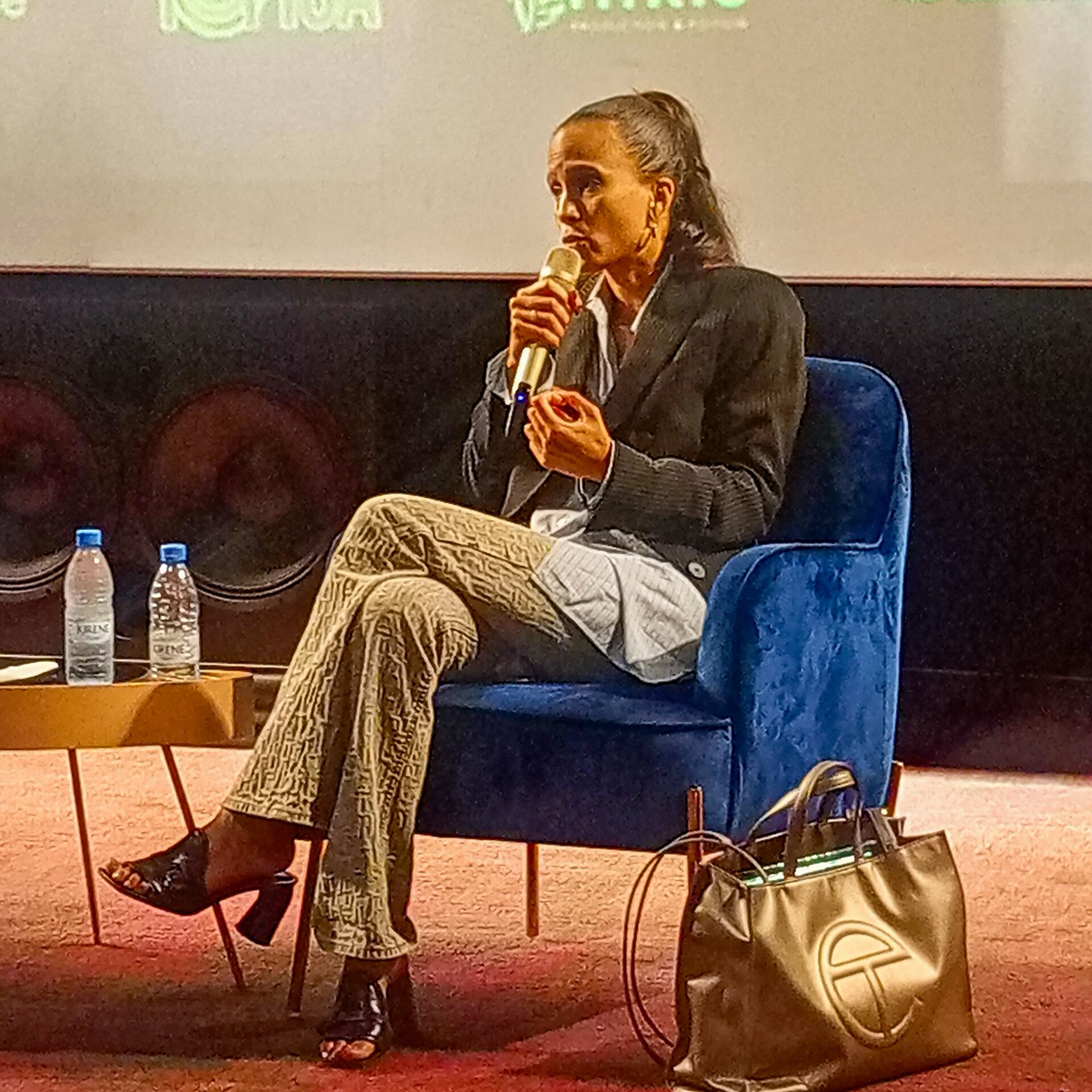
Mati Diop at a screening of Dahomey at Sea’nema in May 2024.4MAPS · CC BY-SA 4.0 · Cropped
Sarah Jilani reviews Mati Diop’s Dahomey, which follows 26 objects returning from France to Benin. Her essay considers how the documentary connects cultural restitution with the work of caring for collections and debates among Beninese students about colonial legacies and the terms of return.
Zeitz MOCAA’s 2024 announcement of Rita Mawuena Benissan’s One Must Be Seated described an exhibition exploring Asante enstoolment through umbrellas, stools, textiles, sculpture, photography and film. Curated by Beata America, the presentation drew on archives and collaboration with Kumasi artisans. Its historical significance lies in connecting Ghanaian traditions of leadership with contemporary artistic practice while recognising the craftspeople who sustain those traditions.
Zeitz MOCAA’s September 2024 announcement described Silo Through the Century: Into the Contemporary as a movable exhibition about the building’s changing uses. Combining archival images, video and objects, it traced the grain silo from its 1924 industrial beginnings to its conversion into a contemporary-art museum. The project placed the institution’s architecture within Cape Town’s economic and cultural history, beyond the centenary celebration itself.
Zeitz MOCAA’s 2024 announcement presented UNDERSTUDIES as Nolan Oswald Dennis’s first major solo exhibition at a South African museum. Curated by Thato Mogotsi, it explored how diagrams, models and collaborative processes could question authority, landlessness and scientific representations of the world. The museum highlighted a soil-based work made with staff and a reconfigured Black Liberation Zodiac, connecting artistic experimentation with collective learning.
In ArtThrob, Claudia Marion Stemberger considered MADEYOULOOK’s Dinokana within Quiet Ground, the 2024 South African Pavilion curated by Portia Malatjie. Her account connected its voices, environmental sounds, suspended plants and spatial arrangements to ancestral relationships with land and water. Rather than treating the pavilion as spectacle, the review explored how the installation asserted Indigenous knowledge and agency against histories of dispossession and colonial representation.
Isa Farfan’s Hyperallergic report examined Kelli Morgan’s launch of the Black Artists Archive in Detroit in July 2024. Encounters with artist and educator Marian Stephens helped turn an exhibition research project into a wider effort to preserve overlooked artistic lineages. Alongside archives held in homes and studios, Morgan envisaged future curatorial and residency programmes supporting living communities outside traditional institutional structures.
ART AFRICA documented the New York presentation of Points of Resonance at The Africa Center, bringing together twelve photographers working across Africa and its diaspora. The exhibition connected approaches to memory, migration and colonial histories through artists including Fatoumata Diabaté, Lebohang Kganye, Sammy Baloji and Maheder Haileselassie. Its move from an initial Egyptian presentation in 2023 added a transatlantic chapter to that conversation.
Sarah Rose Sharp reported in Hyperallergic on Kinship: The Legacy of Gallery 7 at the Museum of Contemporary Art Detroit. Curated by Abel González Fernández, the exhibition revisited the artist-run space Charles McGee established in 1969 and its commitment to Black abstraction. By pairing foundational participants with later artists, including Elizabeth Youngblood and Gilda Snowden, the show treated that history as an ongoing artistic inheritance.