In July 2023, Zeitz MOCAA announced two exhibitions examining cultural solidarity and political struggle: Past Disquiet and Seismography of Struggle. The former included research on art opposing apartheid; the latter assembled journals associated with liberation movements across Africa, Asia and the Americas. A symposium and the publication Radical Solidarity: A Reader accompanied the programme, extending conversations begun during the museum’s online gathering in 2020.
ART AFRICA introduced Common Ground at Nairobi Contemporary Art Institute as an examination of how groups occupy social and physical space. Works by Peterson Kamwathi, Elias Mung’ora, Paul Njihia and Morris Foit depicted students, officers, protesters and families. The selection included a newly completed five-part Foit sculpture in the institute’s collection, connecting contemporary public life with the material and intergenerational histories of Kenyan art.
ArtReview reported the artist list and framework for the 35th Ljubljana Biennale of Graphic Arts, led by Ibrahim Mahama. From the void came gifts of the cosmos connected post-independence Ghana with former Yugoslavia through Kwame Nkrumah’s ideas and histories of non-alignment. Exit Frame Collective’s public programme drew on the Akan concept of council, positioning printmaking and contemporary art as means of building cultural relationships.
ART AFRICA reported on Otherscapes at Joburg Contemporary Art Foundation, bringing large installations by Nicholas Hlobo, Sethembile Msezane, Siemon Allen and Wim Botha into dialogue. The works approached belonging and national identity through spatial environments visitors could move around or through. Rather than illustrating a political verdict, the exhibition asked how memory, spirituality and colonial histories complicate the distance between democratic aspiration and contemporary disappointment.
ART AFRICA·
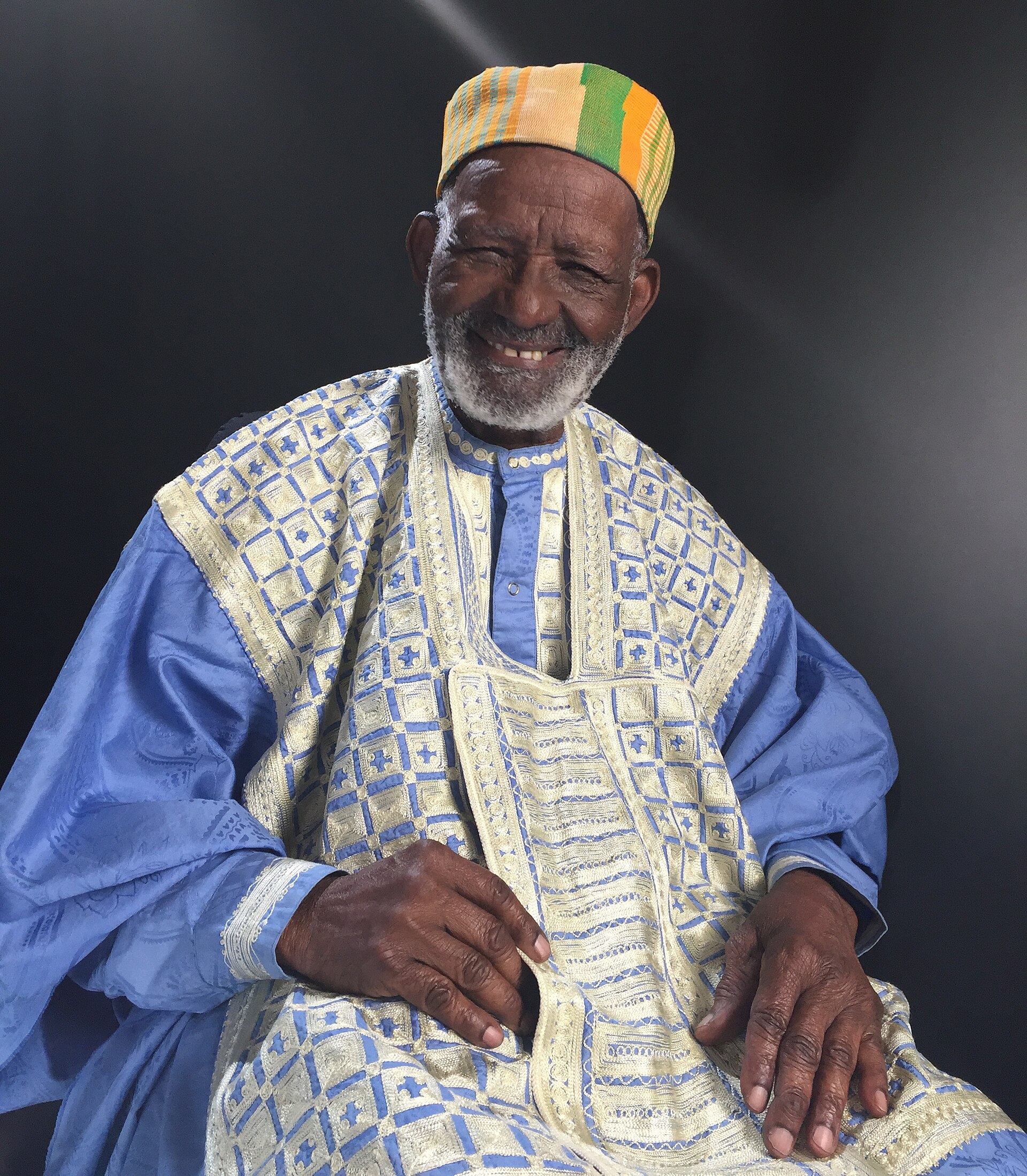
James Barnor, photographed in 2019. His 2023 Detroit retrospective is not pictured.CPFGalerie · CC BY-SA 4.0 · Cropped
ART AFRICA announced James Barnor’s first United States retrospective at the Detroit Institute of Arts. The exhibition’s programme spanned Ghana and the African diaspora in Britain, tracing social change through portraiture, journalism and fashion, alongside plans to recreate the photographer’s early studio environment.
ART AFRICA reported that Amoako Boafo expanded his Gagosian debut into a presentation at dot.ateliers in Accra, adding new portraits to paintings first seen in New York. The exhibition connected international circulation with an artist-built local infrastructure: Boafo’s space, opened in December 2022, combined galleries, studios and an art library with residencies. It documented a concrete effort to retain artistic exchange and experimentation within Accra.
Reviewing Wangechi Mutu’s Intertwined for Hyperallergic, Hrag Vartanian argued that her recent sculptures brought the fragmented energies of her drawings and collages into new material forms. He praised her handling of scale and imaginative treatment of African and feminine power while questioning several installation choices. The review recorded a major survey as a moment of artistic development, not simply a retrospective celebration.
ART AFRICA reported on Afriart Gallery’s Shapes of Water, which assembled ten women artists from seven African countries in Kampala. Water supplied a framework for considering femininity, bodily autonomy and the pressure to conform under patriarchy. Participants included Sungi Mlengeya, Charlene Komuntale, Nelsa Guambe and Maliza Kiasuwa. The exhibition placed distinct regional practices in conversation rather than presenting a single model of womanhood.
ART AFRICA covered Phoka Nyokong’s Museum of New Hymns for the Confused at Johannesburg’s Absa Gallery. Paintings developed during a 2022 NIROX residency continued the artist’s investigation of African cultural heritage and its violent entanglements with anthropology, religion and museum classification. The presentation followed his Gerard Sekoto award, offering an example of how residency and award support translated into a sustained critical body of visual work.
Irini Zervas’s Hyperallergic review examined the Americas Society’s first US solo exhibition of Arthur Bispo do Rosario. Seventy-one works demonstrated how the Afro-Brazilian artist transformed available fabrics, threads and found objects during decades of institutionalisation. Rather than reducing the work to biography, the review attended to banners, miniature objects and garments as intricate systems of memory, spiritual purpose and resistance to the erasure of an individual life.
Elaine Velie’s Hyperallergic report explored Lauren Halsey’s roof commission at the Metropolitan Museum. Egyptian architectural forms carried portraits of people close to the artist and inscriptions drawn from South Central Los Angeles. Built from hundreds of tiles, the installation connected Afrofuturist imagination with the preservation of a neighbourhood’s everyday language, asking whose culture museums make permanent while communities face the pressures of gentrification.
ART AFRICA described Syowia Kyambi’s return to a Nairobi solo presentation after seven years, at Nairobi Contemporary Art Institute. Kaspale assembled photography, video, sculpture and installations made between 2018 and 2022. The artist’s trickster character moved through colonial archives and inherited sites of power, drawing on research at Tanzania’s Amani Research Station and the MARKK Museum to examine violence, memory and the construction of identity.
ART AFRICA previewed the Museum of the African Diaspora’s presentation of Black Venus, curated by Aindrea Emelife. More than 45 contemporary works were set against archival representations reaching back to 1793, examining how Black women have reclaimed control over their images after centuries of fetishisation. Artists including Zanele Muholi, Carrie Mae Weems and Deana Lawson made the exhibition a cross-generational dialogue about agency rather than a catalogue of imposed stereotypes.
Gervais Marsh’s December 2022 Hyperallergic review examined the Kingston Biennial’s presentation of 24 Jamaican artists living locally and abroad. Under the theme Pressure, installations, painting and film addressed migration, spirituality and historical memory. Marsh highlighted exchanges between works by Kaleb D’Aguilar, Ricardo Edwards and Simon Benjamin while questioning the exhibition’s confinement to one floor of the National Gallery. The review preserved both the artistic range and curatorial tensions of the edition.
ArtReview reported Veronica Ryan’s 2022 Turner Prize win for her exhibition Along a Spectrum at Spike Island and her Hackney commission commemorating the Windrush generation. The public sculptures enlarged Caribbean fruits in marble and bronze, while the gallery work explored ordinary materials through careful acts of making. Ryan received the £25,000 award at a ceremony at St George’s Hall in Liverpool.
Zeitz MOCAA’s November 2022 announcement outlined When We See Us: A Century of Black Figuration in Painting, bringing nearly 200 works by 154 artists into dialogue. Curated by Koyo Kouoh and Tandazani Dhlakama, the Cape Town exhibition approached Black self-representation through themes including everyday life, joy, spirituality and emancipation. A publication and discussion programme accompanied the exhibition, which was scheduled to open on 20 November 2022.
In her October 2022 Hyperallergic review, Catherine Yang considered Wangechi Mutu’s Storm King exhibition through its connections between women, mythology and the natural world. Bronze baskets containing tortoise shells, snakes or braided hair extended the artist’s hybrid visual language outdoors. Yang read the intertwined figures of In Two Canoe, also a functioning fountain, as an image of partnership and imagined ecological coexistence rather than a retreat from contemporary crises.
ART AFRICA’s October 2022 report outlined the thirteenth Bamako Encounters, scheduled across venues including Mali’s National Museum and Bamako railway station. The photography biennial planned contributions from around 75 artists, with five thematic chapters drawing on Aimé Césaire. Artistic director Bonaventure Soh Bejeng Ndikung and a collaborative curatorial team foregrounded layered identities and heritage; announced retrospectives included Samuel Fosso, Joy Gregory and Maria Magdalena Campos-Pons.
Dan Hicks’s June 2022 Hyperallergic report examined Hew Locke’s Foreign Exchange, an Ikon commission for Birmingham’s Commonwealth Games festival. Locke placed the city’s Queen Victoria statue aboard a fabricated ship alongside five smaller versions of the monarch. Rather than removing the monument, the intervention used added figures, crates and military imagery to examine, in Hicks’s reading, the circulation of imperial symbols. Hicks connected the work to Locke’s childhood encounters with another Victoria statue in Guyana.
ART AFRICA reported that Zeitz MOCAA’s Indigo Waves and Other Stories would open on 30 June 2022, examining the Indian Ocean’s role in connecting African and Asian histories. Curated by Natasha Ginwala and Bonaventure Soh Bejeng Ndikung with Michelangelo Corsaro, the exhibition included commissions involving Thania Petersen, Myriam Omar Awadi and Shiraz Bayjoo. Its historical focus encompassed migration, colonial trade and cultural exchange, extending accounts of diaspora beyond the Atlantic.