Caleb Oheneba-Takyi examines African participation in Art Dubai’s 2026 edition, focusing on Galerie Atiss Dakar, GVCC, Efie Gallery and artist Yaw Owusu. The essay recognises their contributions while arguing for broader representation, placing gallery participation within a larger discussion about access, cultural exchange and the structures that connect African art with international audiences.
In a December 2025 review for Contemporary And, Roli O’tsemaye reflected on the Re:assemblages Symposium in Lagos. Convened by G.A.S. Foundation and Yinka Shonibare Foundation, the gathering explored African and diasporic art archives through performances, workshops and discussion. The review described artist-led approaches to memory and shared custodianship, alongside the launch of the African Arts Libraries Lab.
Jasmine Weber’s Hyperallergic review examined the first monograph devoted to Coreen Simpson, published in Aperture’s Vision & Justice series. Covering street portraits, nightlife and celebrity photographs, the book placed her decades-long documentation of Black style alongside her work as a jewellery designer. Weber connected Simpson’s intimate, dignified portrayals to wider diasporic photographic traditions, showing how everyday self-presentation can become a sustained form of cultural memory.
Clara Maria Apostolatos’s Hyperallergic review read MoMA’s Wifredo Lam retrospective as a reassessment of an artist once marginalised within the museum’s modernist narrative. She traced Lam’s engagement with African and Afro-Caribbean traditions without reducing him to a follower of European Surrealism. The review also questioned how fully the galleries addressed the racialised frameworks surrounding his career, finding richer treatment of some of those tensions in the catalogue.
In a November 2025 essay for Contemporary And, Afi Venessa Appiah connected Black Canadian publishing histories with contemporary artist-book production and archival practice. Discussing Anteism Books, Artexte and her own imprint, she explored how small presses, tactile formats and digital tools can support cultural memory and the circulation of underrepresented work.
In a Hyperallergic interview, Alison Saar reflected on the family, historical research and material experimentation behind a practice centred on Black women and girls. The feature marked her recognition as the twentieth David C. Driskell Prize recipient at Atlanta’s High Museum. Saar connected her sculptures’ reclaimed tools and agricultural imagery to resistance, while stressing the mutual importance of artists and scholars in sustaining African American art.
In an ART AFRICA interview about Roots of Resilience at the Sainsbury Centre, Tesfaye Urgessa discussed portraying vulnerability and strength together rather than assigning a single emotion to a figure. He described how encounters with the museum’s collection prompted new work and how Ethiopian iconography remained present in his practice without deliberate imitation. His account framed painting as a way to make others’ experiences felt, rather than claiming that art immediately resolves injustice.
In ArtThrob, Nkgopoleng Moloi interviewed Clive Kellner about the Joburg Contemporary Art Foundation’s non-collecting, research-led model. Kellner described free public programming that places Johannesburg artists in dialogue with the wider Global South and builds audiences through exhibitions, publications and talks. The discussion highlighted MADEYOULOOK’s Dinokana in the Structures exhibition, alongside the foundation’s effort to connect local knowledge, architectural history and international artistic exchange.
Writing for ArtThrob, Lukho Witbooi considered how the 2025 group exhibition Thresholds at Southern Guild in Cape Town approached relationships between people, materials and land. The review examined works by Amine El Gotaibi, Simphiwe Buthelezi, Patrick Bongoy and others, connecting their different practices to memory, cosmology and environmental histories.
Nkgopoleng Moloi’s ArtThrob interview examined the new Standard Bank Art Lab at Nelson Mandela Square through curator Same Mdluli’s ambitions for wider public access. Its inaugural textile exhibition included Gladys Xaba and the Katlehong Community Centre alongside loans from tapestry studios. Moloi weighed the possibilities of encountering historical art in a shopping centre against questions about corporate collecting, colonial commercial histories and who such spaces actually reach.
Writing in Contemporary And in July 2025, Ann Mbuti reflected on her participation in Mangrove Ecologies, a collaborative residency and research project linking Lamu and Basel. The work brought sound, installation, workshops and community conversations into dialogue with coastal environments. Mbuti questioned how artistic exchange is shaped by unequal resources and how its effects might be understood beyond conventional measures of impact.
Zada Hanmer’s 2025 ArtThrob review explored Daneel Thumbiran’s Brahmacarya at Johannesburg’s Bag Factory. Part of the Young/Unframed programme, the exhibition combined Hindu imagery, city scenes and collage to examine the artist’s layered South African Indian identity. Hanmer considered how wheat-pasted works moved between the visual languages of public space, personal reflection and the gallery.
In a July 2025 ArtThrob review, Emily Freedman examined Aaron Philander’s Nanna’s Kitchen at AVA Gallery. Philander assembled tools, furniture and other inherited or discarded objects into sculptures exploring family histories, domestic labour and coloured identity in South Africa. Freedman read the works as acts of remembering that also reconsider how everyday objects carry cultural knowledge.
Nolan Stevens reviewed Usha Seejarim’s Unfolding Servitude at Southern Guild in Cape Town for ArtThrob in April 2025. The exhibition repurposed clothes pegs, serving trays and ironing soleplates into sculptural forms. Stevens linked these material transformations to the artist’s examination of gendered expectations, domestic work and the often-unrecognised labour of care.
Alexandra M. Thomas’s Hyperallergic review examined the Brooklyn Museum’s Elizabeth Catlett retrospective through the artist’s commitments to Black and Mexican liberation. Prints, sculpture and public works connected her representations of women’s labour to her participation in Mexico’s Taller de Gráfica Popular. Thomas emphasised the transnational exchanges and community relationships that shaped Catlett’s practice, treating political organising as integral to her artistic achievement.
Debra Brehmer’s Hyperallergic review of Nordic Utopia? at the Chazen Museum examined Black American artists who worked in Scandinavia. Paintings and objects associated with William H. Johnson, Herbert Gentry, Ronald Burns and Howard Smith complicated familiar accounts centred on Paris. Brehmer described the creative room afforded by migration while noting that the exhibition did not equate life abroad with an uncomplicated escape from racism.
Hyperallergic·
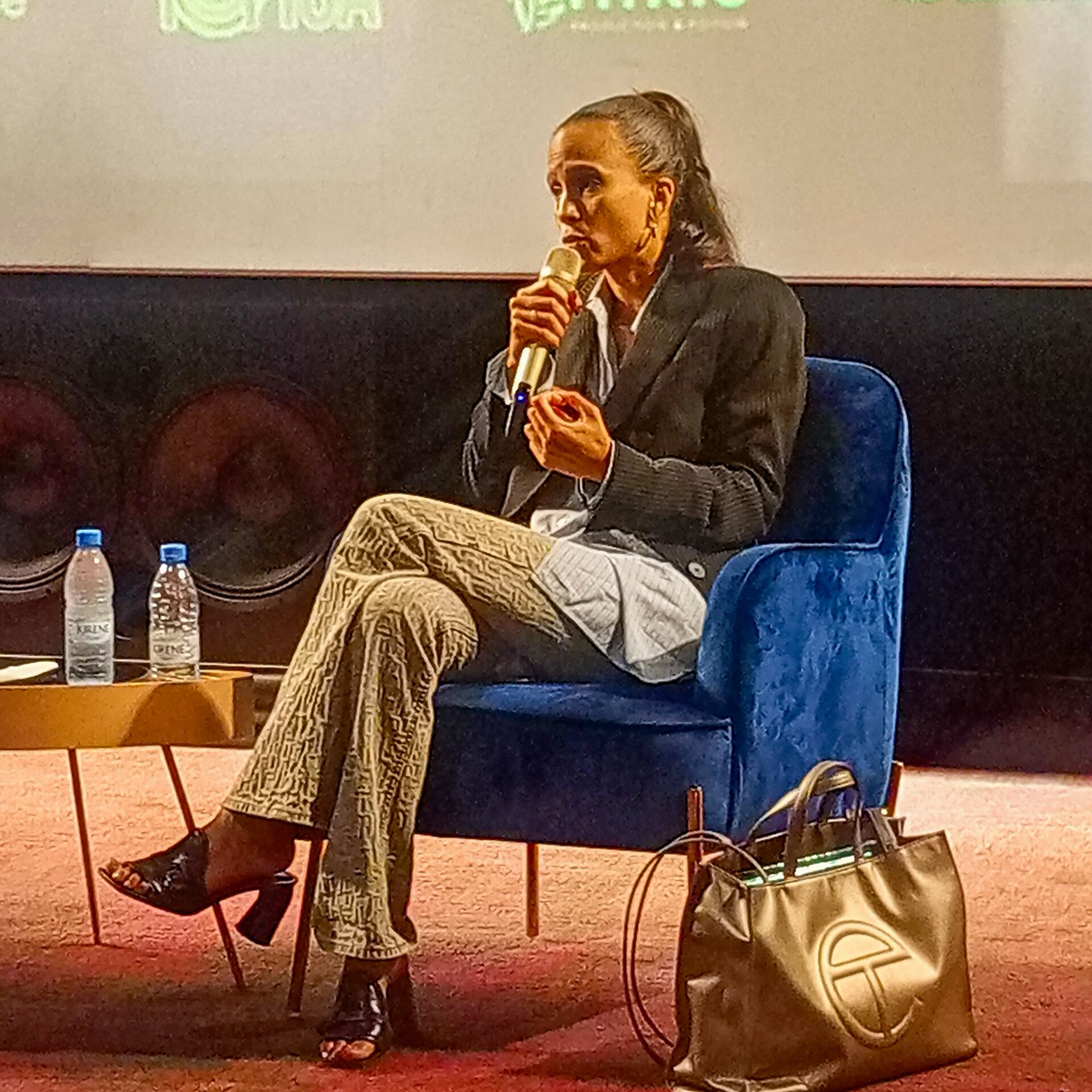
Mati Diop at a screening of Dahomey at Sea’nema in May 2024.4MAPS · CC BY-SA 4.0 · Cropped
Sarah Jilani reviews Mati Diop’s Dahomey, which follows 26 objects returning from France to Benin. Her essay considers how the documentary connects cultural restitution with the work of caring for collections and debates among Beninese students about colonial legacies and the terms of return.
In ArtThrob, Claudia Marion Stemberger considered MADEYOULOOK’s Dinokana within Quiet Ground, the 2024 South African Pavilion curated by Portia Malatjie. Her account connected its voices, environmental sounds, suspended plants and spatial arrangements to ancestral relationships with land and water. Rather than treating the pavilion as spectacle, the review explored how the installation asserted Indigenous knowledge and agency against histories of dispossession and colonial representation.
Voni Baloyi’s ArtThrob review of Esther Mahlangu’s Iziko retrospective considered how a major survey could honour both an individual artist and the Ndebele community sustaining her practice. The account discussed curator Nontobeko Ntombela’s thematic approach, the returned BMW Art Car and less-familiar figurative works. Baloyi argued for placing Mahlangu within broader histories of South African abstraction, Black women artists and communal cultural preservation.
Margot Dower’s ArtThrob review of Georgina Maxim’s Telling Moments at Goodman Gallery, London, focused on six works assembled from clothing and embroidery. The Zimbabwe-based artist’s use of dhunge mutunge, a temporary stitching technique, became a way to consider memory, women’s lives and the limits of repair. Dower resisted flattening the work into a general textile-art trend, stressing the specificity of its methods and context.