ArtThrob’s review of the inaugural Stellenbosch Triennale examined how contemporary African art engaged a town marked by unequal histories and restricted access. The critic singled out installations by Sethembile Msezane, Bronwyn Katz and Ibrahim Mahama for their attention to land, memory and labour. Alongside praise, the review questioned uneven artistic contributions, visa barriers and the durability of an ambitious noncommercial platform funded by local investors and businesses.
Reflecting on an Ernest Mancoba symposium at Cape Town’s A4 Foundation, ArtThrob argues that fixed artistic and national categories can flatten a complex life. The essay considers Mancoba’s movement between South Africa and Europe, his family’s collaborative intellectual life, and his work across abstraction and figuration. It welcomes renewed attention while questioning attempts to fit the artist neatly into a single modernist or national canon.
ArtThrob’s review of Michael Armitage’s Accomplice at Norval Foundation examined paintings responding to Kenya’s 2017 elections. Drawing on a conversation between the artist and curator Owen Martin, it considered how moving bodies, landscapes and blurred imagery convey political experience. The critic also explored Armitage’s use of Lubugo bark cloth, whose uneven surface becomes part of the paintings’ composition and connects material choices with cultural history.
ArtThrob reviewed Givan Lötz’s Unearthly at Cape Town’s AVA Gallery in early 2020, focusing on the relationship between textured paintings and sculptural forms. Encaustic surfaces and assembled branches encouraged connections between imagined landscapes, bodily sensations and natural cycles. The critic saw the exhibition’s refusal of easily recognizable shapes as an invitation to reconsider human assumptions about the world, praising its capacity to sustain uncertainty rather than resolve it.
In a 2020 review, ArtThrob brought together Igshaan Adams’s stukkinne stories and Sabelo Mlangeni’s The Royal House of Allure at blank projects. Adams’s textiles and sculptures drew on domestic histories in Bonteheuwel, while Mlangeni’s photographs followed life within a queer household in Lagos. The review traced connections between material traces, chosen family and intimacy, considering how both practices resist the disappearance of overlooked experiences.
In its review of Barthélémy Toguo’s Bilongue at Stevenson Cape Town, ArtThrob considered how portraits of people in Douala brought contemporary life into conversation with colonial archives. Watercolours, drawings and carved wooden faces explored memory and human connection. The critic interpreted photographs inserted into portraits and stamp-like borders as challenges to imposed accounts of African history, emphasizing care and empathy as central to the exhibition’s treatment of its subjects.
ArtThrob’s January 2020 review of Otobong Nkanga’s Acts at the Crossroads at Zeitz MOCAA considers how her drawings, textiles, photographs and installations connect bodies, land and resource extraction. The critic reads the survey through networks of mutual influence rather than a hierarchy separating humanity from nature. Works including Social Consequences II and Taste of a Stone become starting points for questions about ecological damage, labour and cultural memory.
ArtThrob·
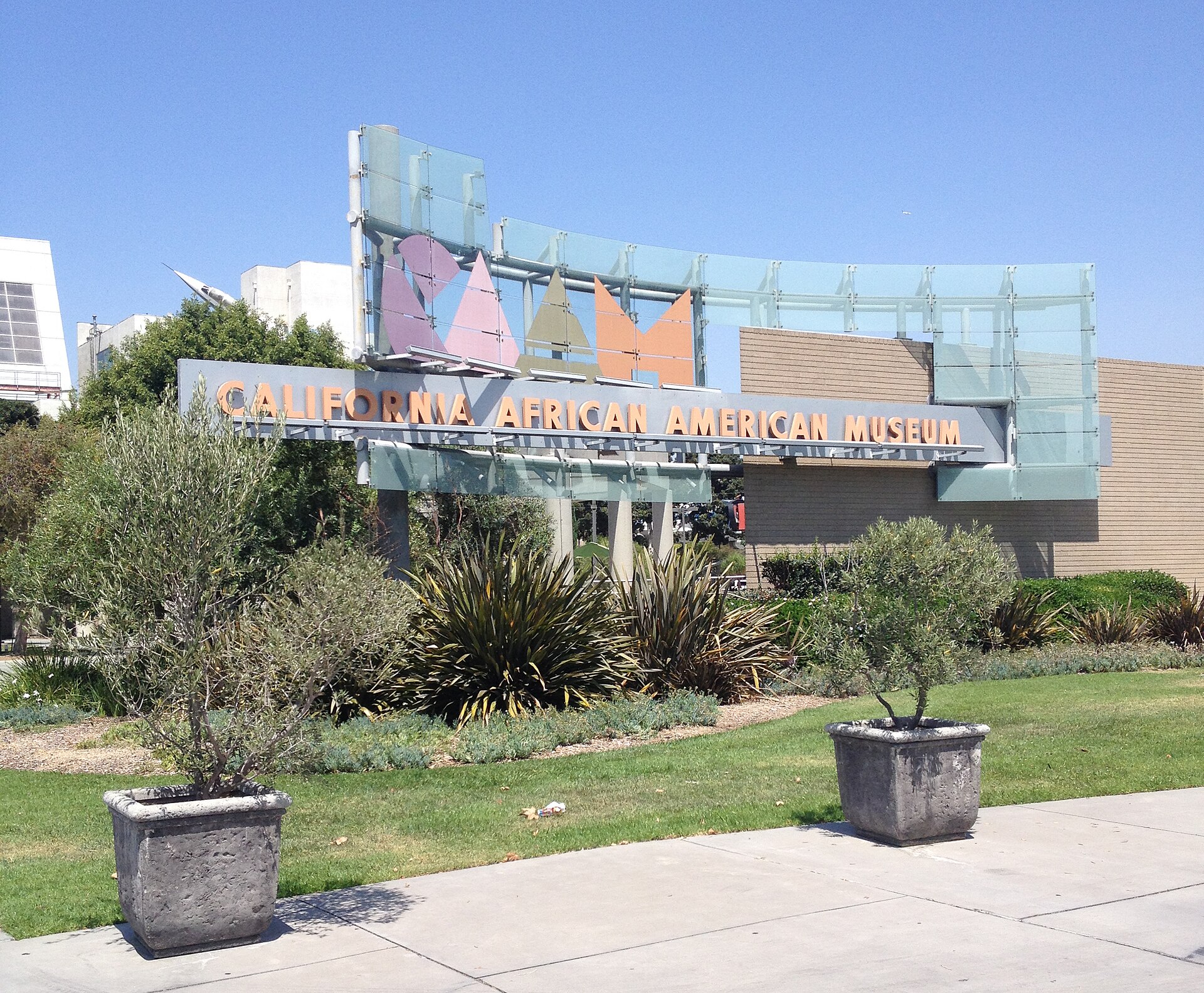
California African American Museum in Los Angeles, photographed on 18 August 2015 (file photograph). The museum hosted Making Mammy.Timtempleton · CC BY-SA 3.0
Writing about the California African American Museum’s Making Mammy exhibition, historian Brenda E. Stevenson examined how films, domestic objects and popular imagery distorted Black womanhood. The article traced the stereotype’s role in romanticizing slavery and obscuring violence, while emphasizing enslaved women’s agency and resistance. The exhibition situated these representations within the wider history of racism in American visual culture, rather than treating them as neutral historical illustrations.
ArtThrob’s January 2020 review examined Ruby Swinney’s Hold Still at WHATIFTHEWORLD in Cape Town. The critic read the artist’s monochromatic oil paintings on silk as unsettling encounters between human leisure and environmental damage. Conservatories, pools and faceless figures become settings for questions about consumption, spectatorship and alienation from nature. The review argued that the apparent serenity of the works gives way to discomfort about their depicted world.
ArtThrob’s January 2020 review of Moshekwa Langa’s Tropic of Capricorn at Stevenson in Cape Town considered works built from unstable forms, layered surfaces and unconventional materials. The critic interpreted their fragmentation as a resistance to settled meaning, relating Langa’s practice to experiences of displacement and uncertainty. Rather than treating the exhibition as a single narrative, the review followed its shifting relationships between matter, memory and perception.
Chad Rossouw’s January 2020 review of Soft Architectures at Goodman Gallery Cape Town examined how built forms organize behaviour and preserve unequal histories. Discussing works by Kapwani Kiwanga, Jeremy Wafer, Naama Tsabar and Mateo López, he explored the relationship between materials and the stories viewers bring to them. His assessment praised the exhibition’s coherence, particularly the dialogue between archival references and sculptures that initially appeared abstract or ordinary.
ArtThrob’s review of Cathy Abraham’s A Deeper Kind of Nothing describes how fragile materials became a means of mourning and collective reflection at Glen Carlou Gallery in Klapmuts. A central installation used thousands of painted eggshells, while another incorporated balloons holding the artist’s breath. The critic considers the shared painting sessions as spaces for remembering lives affected by gender-based violence and for confronting the difficulty of recovery.
Laura Raicovich reflects on The NewOnes, will free Us, Wangechi Mutu’s four bronze figures installed in the Metropolitan Museum of Art’s façade. She reads their seated poses, coiled garments and reflective surfaces as a challenge to the building’s monumental authority and inherited European conventions. The essay connects the sculptures with questions of colonial history, Black presence and forms of beauty that dominant cultural narratives have excluded.
Jasmine Weber’s review of the 2019 1-54 Contemporary African Art Fair in New York follows connections between studio portraiture and newer photographic experiments. Works by Seydou Keïta, Malick Sidibé and J. D. ‘Okhai Ojeikere appear alongside artists including Hassan Hajjaj and Lebohang Kganye. Weber traces recurring concerns with beauty, family, identity and representation across African and diaspora practices, while highlighting photography’s exchanges with textiles, sculpture and collage.
After seeing William Kentridge’s More Sweetly Play the Dance at the Milwaukee Art Museum, Debra Brehmer reflects on the procession of figures moving across its eight screens. Her essay relates the South African artist’s images of burdens and confinement to a nearby protest against US immigration policies. The connection is the critic’s interpretation, extending into a self-examination of privilege, segregation and the limits of solidarity.
Diana Sette reviews The Ecstasy of St. Kara, an exhibition of Kara Walker’s drawings at the Cleveland Museum of Art. Developed after a period working in Rome, the works bring religious imagery into contact with histories of enslavement, racial violence and Black self-determination in the United States. Sette reads their recurring figures and scenes as an examination of martyrdom, oppressive narratives and the possibility of resisting inherited violence.
Gontse Mathabathe reviews the tenth-anniversary presentation of Zanele Muholi’s Faces and Phases at Stevenson in Johannesburg. The exhibition placed earlier portraits beside newer photographs of the same participants, making change over time central to its living archive of Black queer lives. Mathabathe emphasizes the project’s political and personal force while noting that participants’ written testimonies, which often accompany the portraits, were absent from this installation.
ArtReview’s Siona Wilson considers Afterword, Kara Walker’s return to the imagery and reception of her 2014 sugar installation A Subtlety. Preparatory drawings, sculptural remnants and films extend the project’s questions about looking. Wilson focuses on An Audience, assembled from footage of visitors during the installation’s final hour, and the contrast between emotional encounters with the work and the habitual production of photographs and selfies.
Reporting from Dak’Art in 2014, Basia Lewandowska Cummings followed the OFF programme through hospitals, restaurants, studios and other spaces beyond conventional galleries. Her C& review describes encounters with Issa Samb’s studio and digital-art activity at Kër Thiossane. It presents the sprawling fringe as a way of connecting artistic work with Dakar’s everyday life, while questioning who gains visibility through the biennial system.
Hrag Vartanian examines Kara Walker’s A Subtlety before its public opening at Brooklyn’s former Domino Sugar Factory. A monumental white sphinx and smaller sugar figures connect the installation to the industry’s reliance on enslaved labor. His review also considers the tensions surrounding the site’s planned redevelopment, asking how a tribute to exploited workers sits within the changing economics and cultural memory of Williamsburg.