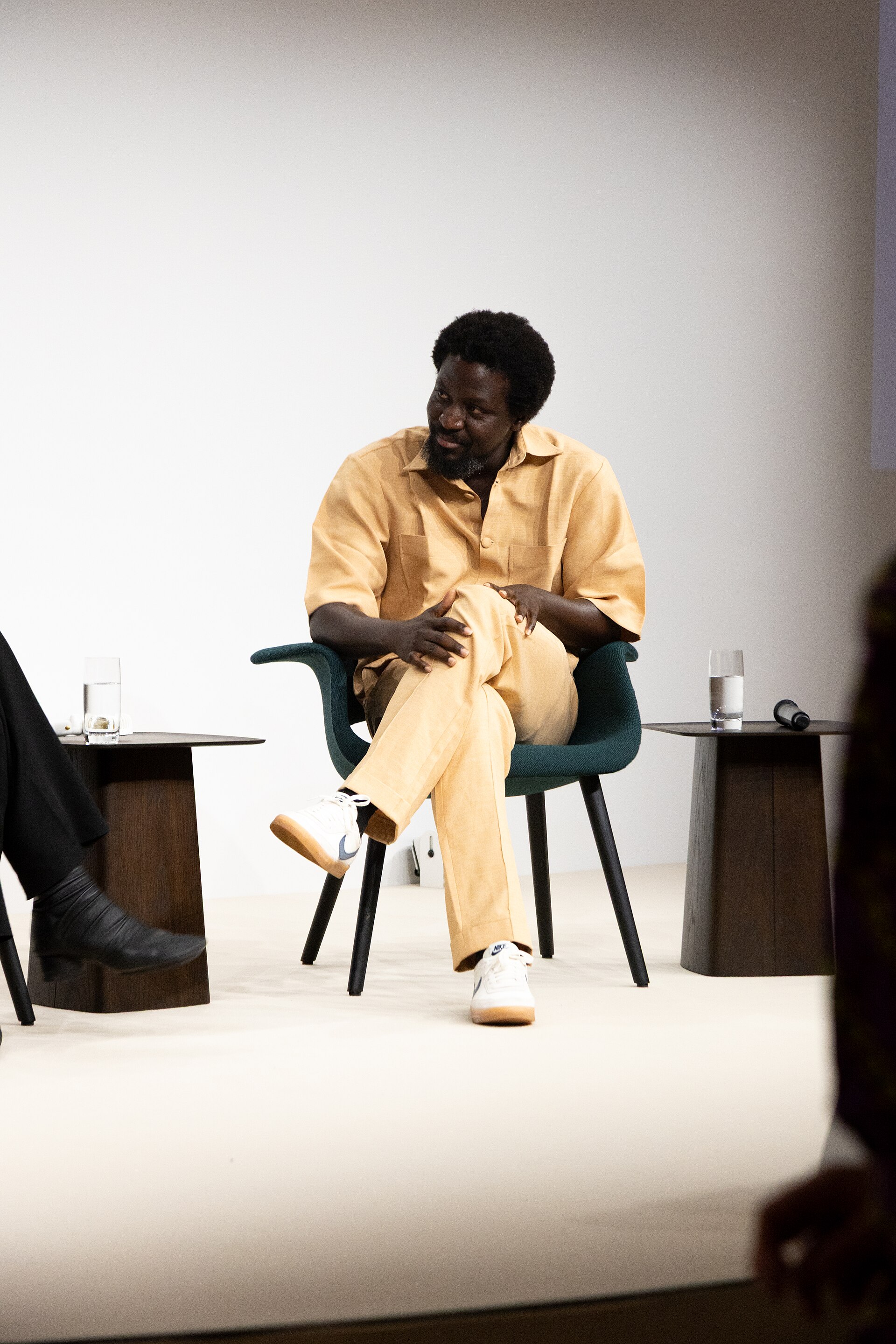
Ibrahim Mahama at Art Basel, June 2025. Photo: Bea Phi, CC BY-SA 4.0. This is not a photograph of the 2022 announcement or the Ljubljana Biennale.Bea Phi · CC BY-SA 4.0
ArtReview reported in June 2022 that Ghanaian artist Ibrahim Mahama would direct the 35th Ljubljana Biennale of Graphic Arts, scheduled for 2023. The announcement connected his appointment to the histories shared by Ghana and Yugoslavia through the Non-Aligned Movement. It also highlighted his institution-building in Tamale, including Nkrumah Volini, the Savannah Centre for Contemporary Art and Red Clay, alongside the large installations for which he is internationally known.
ArtReview·
Ibrahim Mahama at Art Basel in June 2025, accompanying this 2022 archive feature. His Tamale institutions are not pictured.Bea Phi · CC BY-SA 4.0 · Cropped
Azu Nwagbogu examines Ibrahim Mahama’s institution-building in Ghana, focusing on spaces for experimentation, learning and public participation. The ArtReview feature considers the Savannah Centre for Contemporary Art and Red Clay in Tamale, relating the artist’s infrastructure projects to wider debates about what museums can do.
Reviewing Simone Leigh’s Sovereignty for Hyperallergic in May 2022, Julie Baumgardner examined how the artist transformed the United States pavilion at Venice. A thatched exterior and monumental bronze and ceramic sculptures questioned colonial representation and national display. The review foregrounded Last Garment, a washerwoman derived from a Jamaican postcard, and Leigh’s stated commitment to Black women as an audience, presenting the pavilion as an argument for self-determination through sculpture.
Hyperallergic·
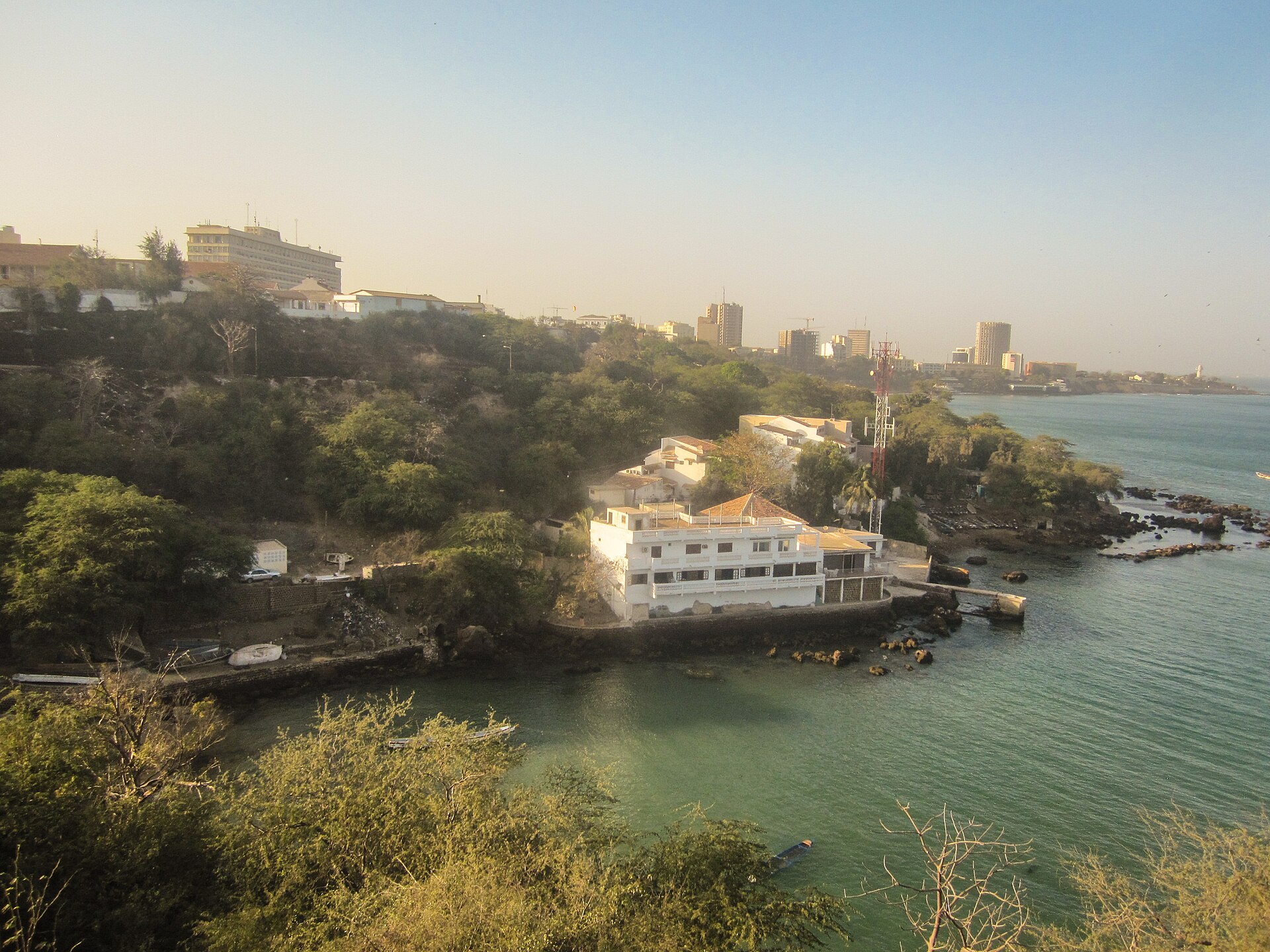
Dakar’s Corniche Est, photographed in 2013. This is an archival city view, not a photograph of the 2022 biennale.jbdodane · CC BY 2.0 · Cropped
ART AFRICA outlines plans for the postponed fourteenth Dakar Biennale under the theme Ĩ NDAFFA #, associated with forging and transformation. The announcement describes an international exhibition, invited curators and projects extending into Dakar’s public spaces, alongside programmes intended to engage audiences across Senegal.
In an ArtReview interview ahead of the 2022 Venice Biennale, curator Nana Oforiatta Ayim discusses Ghana’s pavilion with Na Chainkua Reindorf, Afroscope and Diego Araúja. She describes the artists as creators of distinct imagined worlds and sees Venice as a setting for exchanging locally rooted narratives. Her account links the new presentation to the interest generated by Ghana’s first pavilion in 2019, while resisting the idea of a single national artistic tradition.
In ArtReview’s April 2022 questionnaire, Sonia Boyce described her forthcoming British Pavilion as a space for improvisation, shared encounters and movement between different media. She resisted treating artistic traditions as neatly national and drew attention to generations of practitioners overlooked by international narratives. Boyce also identified Claudette Johnson’s work as an enduring influence, offering a direct account of the artistic relationships informing her Venice presentation.
Jasmine Liu reported for Hyperallergic in March 2022 that the Colby College Museum of Art had acquired Faith Ringgold’s Coming to Jones Road #4: Under A Blood Red Sky, made in 2000. Combining painted imagery and written narrative, the quilt follows people escaping enslavement through the Underground Railroad. The acquisition brought an important example of Ringgold’s storytelling practice into Colby’s collection,.
Zeitz MOCAA’s February 2022 programme paired Tracey Rose’s retrospective Shooting Down Babylon with Goldendean’s inflatable installation Soft Vxnxs. The museum described Rose’s work as a complex engagement with contemporary political and social questions. Goldendean invited visitors to touch the sculpture, using physical presence and participation to explore visibility, embodiment and the entitlement to occupy space. The announcement scheduled the exhibitions to open three days apart.
Kriston Capps’s January 2022 Hyperallergic review examined the Phillips Collection’s anniversary programme through Black abstraction. Retrospectives of Alma Thomas and David Driskell were accompanied by commissions involving Victor Ekpuk and Nekisha Durrett, and an installation by Sanford Biggers. Capps connected these presentations to Washington’s artistic histories, while asking whether this institutional attention would continue beyond a single celebratory season.
Zeitz MOCAA’s January 2022 release announced Shooting Down Babylon, a large retrospective of South African artist Tracey Rose. The museum described a presentation spanning three decades and bringing together performance, film, installation and other media to examine liberation, colonial legacies and the body. It also announced new Mandela Balls commissions, positioning Rose’s confrontational and often satirical practice within a broader discussion of resistance and reckoning.
Zeitz MOCAA·
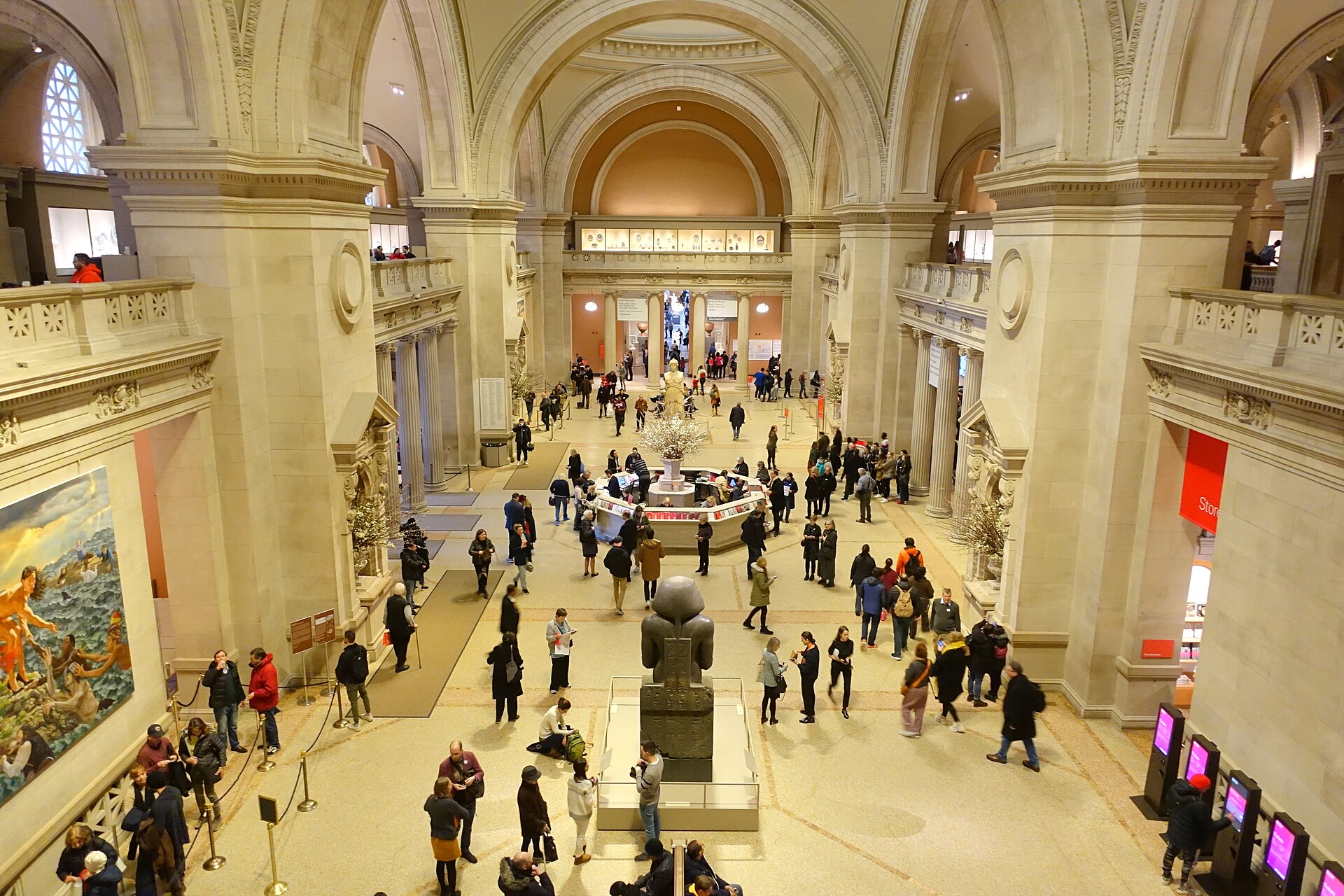
The Metropolitan Museum of Art’s Great Hall, photographed in February 2020. The Afrofuturist Period Room is not pictured.Daderot · CC0 · Cropped
Hyperallergic examines the Metropolitan Museum of Art’s Afrofuturist period room, which combines historical objects with contemporary work by Black artists and designers. The installation imagines descendants of Seneca Village’s displaced residents, bringing different eras into one domestic setting while reconsidering whose histories traditional museum rooms represent.
Zeitz MOCAA’s 2021 announcement introduced Only Sun in the Sky Knows How I Feel, a survey of Johannes Phokela’s painting spanning three decades. Alongside earlier work, the exhibition included new large canvases and archival material illuminating his process. The museum framed his engagement with European pictorial traditions as a means of questioning power and inherited value systems. Koyo Kouoh and Storm Janse van Rensburg co-curated the presentation.
Anya Brilus’s ArtThrob review examines how Georgina Gratrix’s exhibition The Reunion at Norval Foundation expands portraiture beyond physical likeness. The Durban-raised artist’s layered paintings of her parents are set against Nine Weeks, a sequence of daily watercolour self-portraits made during South Africa’s 2020 lockdown. Brilus interprets the contrasting materials and repeated faces as records of relationships, memory and changing emotional experience.
Zeitz MOCAA announced Thania Petersen’s KASSARAM as an open-studio residency running from 27 May to 17 October 2021. Centred on her film of the same name, the project examined how representations of culture can create divisions and obscure community histories. The Cape Town artist planned to develop the film’s imagined setting within the museum, giving visitors access to research and making connected to her heritage and identity.
Writing for ArtThrob, Francia Pratt considers how a pairing at Zeitz MOCAA connects memory with domestic life and material form. Her review brings Njideka Akunyili Crosby’s mixed-media painting Sunday Morning into conversation with Joël Andrianomearisoa’s fabric work. Pratt reads the photographic fragments and textile surfaces as different ways of holding personal histories, absence and bodily experience, showing how the exhibition’s paired presentation creates connections across distinct artistic practices.
Zeitz MOCAA announced Senzeni Marasela’s first museum solo exhibition for December 2020. Waiting for Gebane centred on Theodorah, an alter ego inspired by the artist’s mother, whose search for an absent husband unfolds through photographs, textiles and performance. The presentation connected this narrative with Marasela’s sustained use of ishweshwe dresses, examining memory, waiting and the experiences of Black women in South Africa.
As part of Home Is Where the Art Is, Zeitz MOCAA outlined three late-2020 discussions on the relationship between art and Cape Town’s communities. The panels addressed care after lockdown, exclusion and representation in the arts, and the conditions needed for a more accessible local art environment. Participants included Bonolo Kavula, Haroon Gunn-Salie and Neo Maditla, with contributions from museum educators and curators.
Zeitz MOCAA presented Alfredo Jaar’s The Rwanda Project in November 2020, drawing on work developed after his 1994 visit to Rwanda and neighbouring countries. The museum described the exhibition as an examination of genocide, collective responsibility and the limits of representing trauma. Curated by Koyo Kouoh and Storm Janse van Rensburg, it considered how distant audiences encounter suffering and how images can register, or fail to register, historical violence.
In September 2020, Zeitz MOCAA announced a five-day online Radical Solidarity Summit linking artists, writers, curators and activists. Its programme addressed Pan-African resistance, publishing, collective practice, urban space and possible cultural futures during the pandemic. Participants included Achille Mbembe, Nontsikelelo Mutiti and Emeka Okereke, while Ghana’s blaxTARLINES KUMASI was invited to take over the museum’s Instagram account during the 14–18 September gathering.
In an August 2020 statement, Zeitz MOCAA said it remained closed because of the pandemic while preparing for a safe return. Koyo Kouoh also announced that the museum’s William Kentridge exhibition, Why Should I Hesitate: Putting Drawings to Work, would travel to Hamburg’s Deichtorhallen that October. Meanwhile, the institution continued online talks, art-making activities and performances while reorganising its exhibition programme.