ART AFRICA revisited Voices from the Earth, a 2019 exhibition at Berman Contemporary in Johannesburg curated by Els van Mourik. Natalie Field discussed human relationships with nature through performance and self-portraiture; Ingrid Bolton connected material experiments with coal extraction and ocean systems; Marian Hester described using shadows to consider forests and ecological loss. Their accounts explored how artistic practice might make environmental uncertainty visible and encourage conversation.
ART AFRICA’s March 2020 feature examined the 21st Sesc_Videobrasil biennial in São Paulo, which included artists and collectives from Africa alongside other regions. Highlighting work by Emo de Medeiros, it described a programme concerned with marginalised communities and belonging beyond national identity. The feature also reproduced catalogue commentary by Sesc São Paulo director Danilo Santos de Miranda, making its institutional perspective explicit.
ART AFRICA·
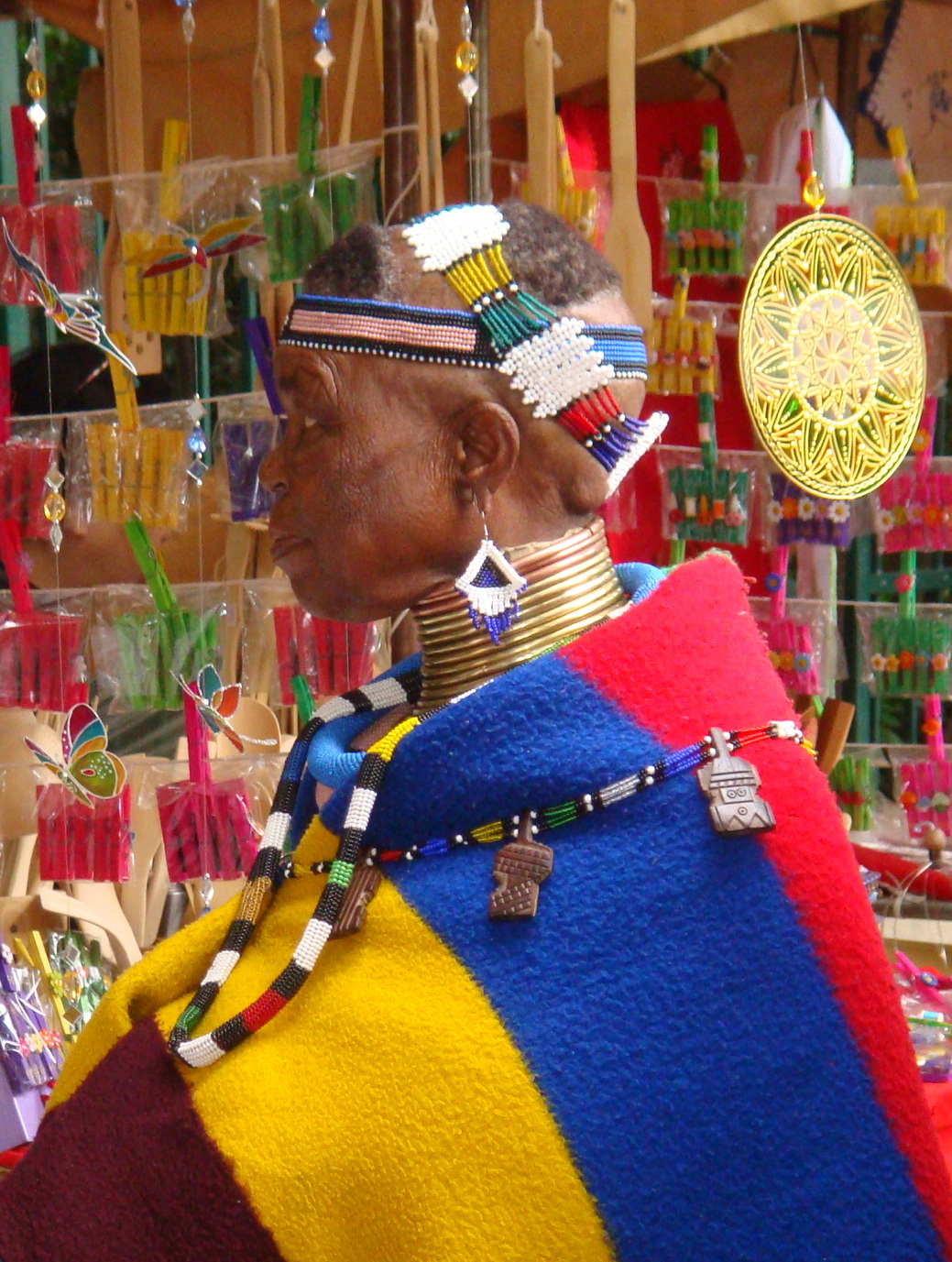
Esther Mahlangu, 2009. Photo: Claudia_midori, CC BY 2.0; cropped by HenriDavel.Claudia_midori · CC BY 2.0 · Cropped
In their March 2020 ART AFRICA editorial, Suzette and Brendon Bell-Roberts connected the issue’s exhibitions and interviews through questions of home and belonging. Their overview moved from Bamako photography and Ségou’s cultural festival to Esther Mahlangu, Mohamed Melehi and François Knoetze. Rather than a single event report, the editorial recorded a cross-regional conversation about migration, identity and the places where artistic communities gather.
ART AFRICA reported FotoFest’s plans for African Cosmologies in March 2020. Curated by Mark Sealy, the Houston biennial’s central exhibition was announced as a focus on artists from Africa and its diaspora, accompanied by a book, films and public discussion. The announcement framed photography through cultural context, representation and human rights; its advertised dates should not be mistaken for confirmation that the full programme proceeded unchanged.
In a March 2020 ArtThrob review, Lucienne Bestall examined Kevin Beasley’s exhibition at A4 Arts Foundation following his Cape Town residency. She described sculptures made with found clothing, photographs and an audio installation assembled from city recordings. Her reading connected these materials with bodily absence, African-American cultural references and the movement of donated garments into South Africa’s informal economy.
ArtThrob published Clive van den Berg’s eulogy for Andrew Verster in February 2020, following the artist’s death and a Durban memorial service. Van den Berg recalled Verster as an exacting teacher and prolific painter whose work extended to writing, performance design and public commissions. The remembrance emphasised his artistic independence and the significance of his frank representation of same-sex desire in South Africa.
A February 2020 announcement named Soukaina Aboulaoula and Cindy Sissokho as associate curators of the fifth International Biennale of Casablanca, working with artistic director Christine Eyene. Their appointments accompanied an emphasis on professional development and knowledge exchange. The announcement also described a partnership with New Art Exchange involving commissions, internships and a symposium, linking curatorial work in Morocco with wider African and international networks.
ART AFRICA’s February 2020 announcement outlined a March Meeting programme connected to Okwui Enwezor’s conception of Sharjah Biennial 15. Proposed participants included Sammy Baloji, Otobong Nkanga and Chika Okeke-Agulu, with discussions examining exhibition-making and transnational exchange. The gathering was planned for 21–23 March, but Sharjah Art Foundation subsequently announced its indefinite postponement. The original article should therefore be read as a historical announcement, not confirmation that the event occurred.
ART AFRICA’s February 2020 announcement introduced Slaghuis II, Thembinkosi Hlatshwayo’s first solo exhibition. Developed through the Market Photo Workshop’s Gisèle Wulfsohn Mentorship with John Fleetwood, the photographs examine experiences of violence through the home and tavern where the artist grew up. The article announced a Johannesburg presentation from 28 February to 29 May 2020 and situated the series within Hlatshwayo’s emerging photographic practice.
ART AFRICA·
View across the Bou Regreg estuary from the Kasbah of the Udayas in Rabat, photographed on 7 June 2010 (file photograph).Adam Jones, Ph.D. · CC BY-SA 3.0
In a 2020 report credited to The Art Newspaper, ART AFRICA described the transfer of the inaugural African Capital of Culture designation from Marrakech to Rabat. The organising committee announced the change in February without giving a reason in its statement, according to the report. The shift disrupted preparations associated with artist Mahi Binebine and prompted debate about cultural investment and centralisation within Morocco.
Reviewing Brett Charles Seiler’s Closet at Goodman Gallery in Johannesburg, ArtThrob considered how paintings, text and an installation evoked queer intimacy, longing and religious exclusion. The critic recognised tenderness in the depicted relationships but questioned the exhibition’s nostalgic focus on familiar white gay cultural figures. The review argued that this framing left insufficient room for Black and brown queer histories and a broader understanding of community.
ArtThrob·
Ibrahim Mahama at Art Basel in Switzerland on 20 June 2025. Mahama participated in the inaugural Stellenbosch Triennale in 2020.Bea Phi · CC BY-SA 4.0
ArtThrob’s review of the inaugural Stellenbosch Triennale examined how contemporary African art engaged a town marked by unequal histories and restricted access. The critic singled out installations by Sethembile Msezane, Bronwyn Katz and Ibrahim Mahama for their attention to land, memory and labour. Alongside praise, the review questioned uneven artistic contributions, visa barriers and the durability of an ambitious noncommercial platform funded by local investors and businesses.
ART AFRICA reported results from Aspire and Piasa’s joint African art auction in Cape Town on 14 February 2020. The sale offered 198 works spanning modern and contemporary practices from the continent and diaspora. Reported prices included R7,055,600 for Marlene Dumas’s Oktober 1973 and R2,503,600 for a William Kentridge work. The article presented the auction houses’ view that cross-border collaboration could broaden collecting networks.
ART AFRICA reported that Haitian-American painter Andy Robert won the Tomorrows/Today prize at the 2020 Investec Cape Town Art Fair. A jury comprising Josh Ginsburg, Bongi Dhlomo-Mautloa and Nana Oforiatta-Ayim selected the artist. Supported by Fondazione Fiera Milano, the award included the planned acquisition of a work for its collection. The report described Robert’s painting as moving between abstraction and recognisable imagery.
ART AFRICA reported on the South African presentation of Lumières d’Afriques at Standard Bank Gallery in 2020. Organised through African Artists for Development, the touring exhibition assembled works by 54 artists, each associated with a different African country, around questions of light and access to energy. Contributions spanned photography, painting, textiles and sculpture, including works by Paa Joe, Athi-Patra Ruga and Nolan Oswald Dennis.
ART AFRICA reported in February 2020 that Esther Mahlangu had created an artwork for the dashboard display of a specially commissioned Rolls-Royce Phantom. The project adapted her Ndebele-inspired geometric painting to the car’s interior. According to the announcement, part of the sale proceeds would support her art school in Mpumalanga and a retrospective exhibition. These were stated plans, rather than independently verified disbursements.
Reflecting on an Ernest Mancoba symposium at Cape Town’s A4 Foundation, ArtThrob argues that fixed artistic and national categories can flatten a complex life. The essay considers Mancoba’s movement between South Africa and Europe, his family’s collaborative intellectual life, and his work across abstraction and figuration. It welcomes renewed attention while questioning attempts to fit the artist neatly into a single modernist or national canon.
ArtThrob’s review of Michael Armitage’s Accomplice at Norval Foundation examined paintings responding to Kenya’s 2017 elections. Drawing on a conversation between the artist and curator Owen Martin, it considered how moving bodies, landscapes and blurred imagery convey political experience. The critic also explored Armitage’s use of Lubugo bark cloth, whose uneven surface becomes part of the paintings’ composition and connects material choices with cultural history.
ArtThrob reviewed Givan Lötz’s Unearthly at Cape Town’s AVA Gallery in early 2020, focusing on the relationship between textured paintings and sculptural forms. Encaustic surfaces and assembled branches encouraged connections between imagined landscapes, bodily sensations and natural cycles. The critic saw the exhibition’s refusal of easily recognizable shapes as an invitation to reconsider human assumptions about the world, praising its capacity to sustain uncertainty rather than resolve it.
ArtThrob’s preview of the 2020 Investec Cape Town Art Fair highlighted film screenings, public discussions and gallery events alongside the commercial booths. Its selections included work by Nnenna Okore, Bonolo Kavula, Sungi Mlengeya and Mawande Ka Zenzile. The guide connected material experimentation with broader conversations about Black women’s subjectivity, museums and sustainable art platforms, offering a record of the fair’s wider cultural programme.