ART AFRICA interviewed Senegalese curator Ousseynou Wade about More than Meets the Eye, the 2025 presentation of the CBH Bank Collection at Geneva’s Musée Rath. Co-curated with Jean-Yves Marin, the exhibition connected early modernists including Albert and Antoinette Lubaki with contemporary artists such as El Anatsui and Zanele Muholi. Wade explained how seven thematic sections brought different African artistic histories into conversation without treating the continent as a single cultural identity.
Speaking with Brendon Bell-Roberts for ART AFRICA in October 2025, Laila Hida described Sangeh Khara at the São Paulo Bienal. The Moroccan artist combined 16mm film, sound and a canopy of reused melhifa cloth to create an environment for reclining and watching. She connected the installation to research in Morocco and Mauritania, reflecting on how textiles, memory and moving images circulate between communities.
Suzette Bell-Roberts interviewed Togolese artist Sadikou Oukpedjo for ART AFRICA about 7 Billion People at the 36th São Paulo Bienal. The installation combined two paintings and a sculpture, using human, animal and hybrid forms to develop the artist’s own symbolic mythology. Oukpedjo described his intuitive approach to making and his wish to prompt viewers to reflect on responsibility and the possibility of change, rather than prescribing one interpretation.
Stephan Rheeder’s ART AFRICA interview explored Canon Griffin Rumanzi’s 2025 exhibition at the Nairobi Contemporary Art Institute. The Ugandan artist combined family photographs, public documents and other archival images into layered digital collages. With curator Trevor Mukholi and artist-researcher Andrea Stultiens, he discussed how these assemblages invite questions rather than claim to reconstruct the past. The conversation also examined History in Progress Uganda’s work in widening access to photographic archives.
In Stephan Rheeder’s ART AFRICA interview, Roméo Mivekannin discussed Correspondances at Fondation H in Antananarivo ahead of its planned opening. Working with Malagasy embroiderers and metalworkers, the French-Beninese artist transformed archival imagery into textile paintings and sculptural altars. He described sewing as a form of care and the exhibition as an exchange among Benin, France and Madagascar. The project brought local craft knowledge into dialogue with his continuing exploration of representation, memory and spiritual traditions.
ART AFRICA·
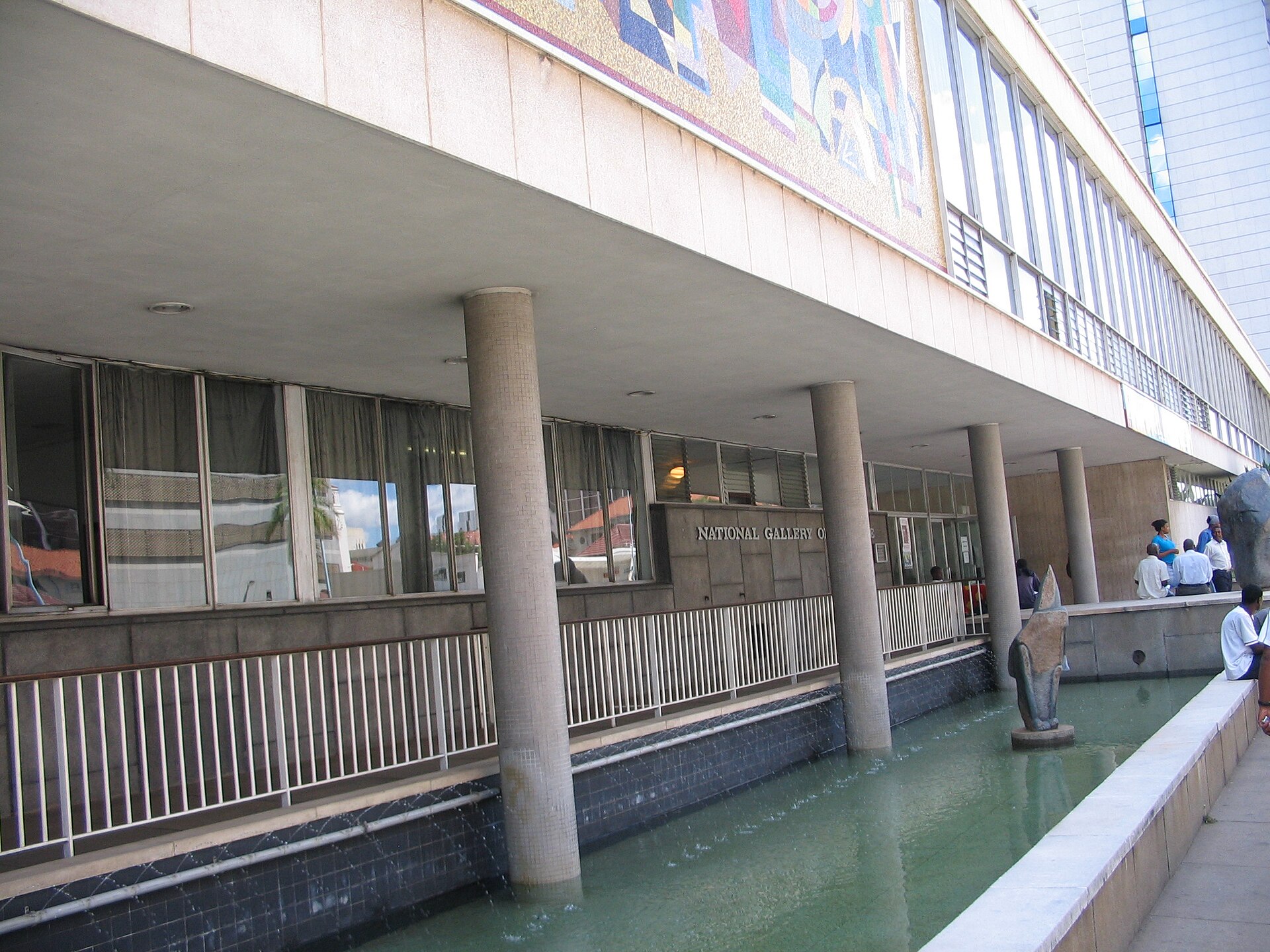
Entrance to the National Gallery of Zimbabwe, photographed in 2007. It does not show the 2026 CIMAM conference.National Gallery of Zimbabwe · CC BY-SA 3.0 · Cropped
In an ART AFRICA interview, Raphael Chikukwa discusses Zimbabwe’s selection to host the 2026 CIMAM Annual Conference. The National Gallery of Zimbabwe director considers how meeting in Africa could strengthen collaboration among museums and bring greater attention to locally developed approaches to leadership and cultural work.
Ivorian artist Joana Choumali turns dawn photographs into layered works using embroidery, sheer fabrics and collage. In this Global Voices interview, she traces the move from documentary photography towards an intuitive practice shaped by memory, faith and inner peace. Her Alba’hian series grew from early walks in Abidjan, while her reflections on scale and hand-stitching show how making art can open a dialogue with both herself and her audience.
Jonah Batambuze discussed The Hands of Gods with Stephan Rheeder for ART AFRICA ahead of its 2025 presentation in Wild at Art at Atelier Mondial in Basel. Combining a short film, sculptural installation and participatory elements, the work drew on the artist’s Black Ugandan–South Indian household. Batambuze described everyday gestures, shared meals and the left hand as ways to explore inherited knowledge and the relationship between personal memory and diasporic identity.
In a May 2025 C& interview with Joshua Segun-Lean, curator Favour Ritaro described developing Archives and Memories at CCA Lagos while working remotely. Research into Bisi Silva’s curatorial archive shaped the exhibition, alongside collaboration with Nigerian women artists and the centre’s team. Ritaro discussed trust, peer critique and careful attention to process as ways to sustain curatorial relationships across distance.
In an ART AFRICA interview, architect Glenn DeRoche described his collaboration with Amoako Boafo for I Do Not Come to You by Chance at Gagosian in London. A timber pavilion evoked the gathering place of Boafo’s childhood courtyard in Accra, while Nkyinkyim combined painting with Ghana-made woven and wooden elements. DeRoche explained how these interventions made community and memory part of the exhibition’s physical experience rather than simply providing a backdrop.
Larissa de Souza spoke to ART AFRICA about Faith Charm, her 2025 exhibition at Simões de Assis in São Paulo. The paintings connected memories of women in her family with experiences in Angola and Afro-Brazilian cultural traditions. Embroidery, beads, tiles and other domestic materials extended the figurative images into textured assemblages. De Souza described this material experimentation as a way to explore ancestry, oral transmission and the experiences of women across the African diaspora.
Alexis Peskine builds portraits from nails and gold leaf, drawing on Afro-Brazilian heritage, family craftsmanship and African spiritual references. Speaking to Global Voices, the Paris-born artist explains how a technique developed during his studies became a way to explore the African diaspora. The interview also follows his shift towards healing and nature in Forest Figures, the body of work shown at London’s October Gallery in 2024.
In an ArtReview interview ahead of the 2022 Venice Biennale, curator Nana Oforiatta Ayim discusses Ghana’s pavilion with Na Chainkua Reindorf, Afroscope and Diego Araúja. She describes the artists as creators of distinct imagined worlds and sees Venice as a setting for exchanging locally rooted narratives. Her account links the new presentation to the interest generated by Ghana’s first pavilion in 2019, while resisting the idea of a single national artistic tradition.
ART AFRICA’s March 2020 interview by Sean O’Toole revisited Carsten Höller’s Fara Fara and its December 2019 screening in Kinshasa. Höller discussed working with Congolese rumba performers and using deliberately altered subtitles to construct an artwork rather than a straightforward documentary. The exchange records tensions between musical context, artistic invention and the reception of a film before an audience familiar with its language and protagonists.
In a March 2020 ART AFRICA interview, Suzette Bell-Roberts spoke with AKKA Project founder Lidija Kostic Khachatourian about connecting African artists with audiences abroad and across the continent. Khachatourian discussed her galleries, collaboration on Mozambique’s 2019 Venice Biennale pavilion and the Art And About Africa platform. The interview records the platform’s intended role in mapping artists, spaces and events, rather than verifying its present-day services or later expansion plans.
In a March 2020 ART AFRICA interview with Sasha Gankin, Bonaventure Soh Bejeng Ndikung reflected on the twelfth Rencontres de Bamako. He connected photography with sound, memory and African diasporic movement, while describing efforts to print work locally and distribute exhibitions across the city. The account presented local production and broader access as practical curatorial choices, documenting the ambitions and difficulties of the biennale’s twenty-fifth-anniversary edition.
ART AFRICA revisited Voices from the Earth, a 2019 exhibition at Berman Contemporary in Johannesburg curated by Els van Mourik. Natalie Field discussed human relationships with nature through performance and self-portraiture; Ingrid Bolton connected material experiments with coal extraction and ocean systems; Marian Hester described using shadows to consider forests and ecological loss. Their accounts explored how artistic practice might make environmental uncertainty visible and encourage conversation.
In a 2020 ART AFRICA interview, Alida Rodrigues explained how collected photographs and botanical imagery developed into The Secret History of Plants. By altering historical portraits, she questions the histories attached to them and the colonial gaze preserved in photographic archives. Rodrigues also described the ethical difficulty of working with images of Black subjects. The series was announced for This Is Not a White Cube’s Cape Town Art Fair presentation.
In a 2020 interview with ART AFRICA, René Tavares discussed how São Tomé and Príncipe’s Tchiloli theatre tradition informed Migrations and Things. Working across painting, drawing and photography, he linked the movement of people and objects with cultural exchange, colonial histories and changing identities. Tavares described memory and heritage as active forces in contemporary life, connecting these concerns with his participation in This Is Not a White Cube’s programme.
In a February 2020 ArtThrob interview, Investec Cape Town Art Fair director Laura Vincenti discussed expanding participation from galleries elsewhere in Africa, including Tunisia, Angola and Côte d’Ivoire. She described sustained conversations with exhibitors and the fair’s role in connecting continental and international markets. The interview records the organiser’s ambitions for greater exchange, ahead of the 14–16 February edition at the Cape Town International Convention Centre.