Tiyani Rikhotso reviewed Lady Skollie’s GROOT GAT at Norval Foundation for ArtThrob, following its final presentation associated with her 2022 Standard Bank Young Artist Award. The paintings drew on San and Khoisan rock art while exploring gaps left by colonial dispossession. Rikhotso described the exhibition’s reimagined cave realm and its tribute to Botswana artist Coex’ae Qgam as acts of self-authored cultural memory.
Nancy Dantas’s ArtThrob feature traced the Casablanca Art School’s challenge to colonial hierarchies through an exhibition in Sharjah. Historical publications, ceramics, murals and archival research connected classroom experimentation with public interventions in Morocco. Dantas emphasised how African, Amazigh, Islamic and Mediterranean inheritances informed a collective modernism, placing the school’s educational ambitions within wider African and Arab cultural networks rather than a narrowly national art history.
Reviewing the Metropolitan Museum’s Harlem Renaissance exhibition for Hyperallergic, Zoë Hopkins highlighted both its international reach and its unresolved debates about Black representation. The 160-work presentation, curated by Denise Murrell, placed well-known figures alongside artists whose contributions had received less attention. Hopkins read its juxtapositions as evidence of artistic freedom, political disagreement and transatlantic exchange, rather than one unified style or obligation.
Writing in ArtThrob after the 2024 Lagos Biennial, Sinazo Chiya examined how its temporary installations reworked the historically charged Tafawa Balewa Square. Works by Bruce Onobrakpeya, Ibrahim Mahama, Victor Ehikhamenor and Tabita Rezaire tested refuge through material, belief and communal space. The review situated those experiments within the square’s colonial, independence and FESTAC histories, finding possibilities for communities to reshape inherited settings.
ArtReview reported the artist list and framework for the 35th Ljubljana Biennale of Graphic Arts, led by Ibrahim Mahama. From the void came gifts of the cosmos connected post-independence Ghana with former Yugoslavia through Kwame Nkrumah’s ideas and histories of non-alignment. Exit Frame Collective’s public programme drew on the Akan concept of council, positioning printmaking and contemporary art as means of building cultural relationships.
Reviewing Wangechi Mutu’s Intertwined for Hyperallergic, Hrag Vartanian argued that her recent sculptures brought the fragmented energies of her drawings and collages into new material forms. He praised her handling of scale and imaginative treatment of African and feminine power while questioning several installation choices. The review recorded a major survey as a moment of artistic development, not simply a retrospective celebration.
ART AFRICA covered Phoka Nyokong’s Museum of New Hymns for the Confused at Johannesburg’s Absa Gallery. Paintings developed during a 2022 NIROX residency continued the artist’s investigation of African cultural heritage and its violent entanglements with anthropology, religion and museum classification. The presentation followed his Gerard Sekoto award, offering an example of how residency and award support translated into a sustained critical body of visual work.
Irini Zervas’s Hyperallergic review examined the Americas Society’s first US solo exhibition of Arthur Bispo do Rosario. Seventy-one works demonstrated how the Afro-Brazilian artist transformed available fabrics, threads and found objects during decades of institutionalisation. Rather than reducing the work to biography, the review attended to banners, miniature objects and garments as intricate systems of memory, spiritual purpose and resistance to the erasure of an individual life.
ART AFRICA previewed the Museum of the African Diaspora’s presentation of Black Venus, curated by Aindrea Emelife. More than 45 contemporary works were set against archival representations reaching back to 1793, examining how Black women have reclaimed control over their images after centuries of fetishisation. Artists including Zanele Muholi, Carrie Mae Weems and Deana Lawson made the exhibition a cross-generational dialogue about agency rather than a catalogue of imposed stereotypes.
Gervais Marsh’s December 2022 Hyperallergic review examined the Kingston Biennial’s presentation of 24 Jamaican artists living locally and abroad. Under the theme Pressure, installations, painting and film addressed migration, spirituality and historical memory. Marsh highlighted exchanges between works by Kaleb D’Aguilar, Ricardo Edwards and Simon Benjamin while questioning the exhibition’s confinement to one floor of the National Gallery. The review preserved both the artistic range and curatorial tensions of the edition.
ArtReview reported Veronica Ryan’s 2022 Turner Prize win for her exhibition Along a Spectrum at Spike Island and her Hackney commission commemorating the Windrush generation. The public sculptures enlarged Caribbean fruits in marble and bronze, while the gallery work explored ordinary materials through careful acts of making. Ryan received the £25,000 award at a ceremony at St George’s Hall in Liverpool.
In her October 2022 Hyperallergic review, Catherine Yang considered Wangechi Mutu’s Storm King exhibition through its connections between women, mythology and the natural world. Bronze baskets containing tortoise shells, snakes or braided hair extended the artist’s hybrid visual language outdoors. Yang read the intertwined figures of In Two Canoe, also a functioning fountain, as an image of partnership and imagined ecological coexistence rather than a retreat from contemporary crises.
Hyperallergic·
Ibrahim Mahama at Art Basel in June 2025, accompanying this 2022 archive feature. His Tamale institutions are not pictured.Bea Phi · CC BY-SA 4.0 · Cropped
Azu Nwagbogu examines Ibrahim Mahama’s institution-building in Ghana, focusing on spaces for experimentation, learning and public participation. The ArtReview feature considers the Savannah Centre for Contemporary Art and Red Clay in Tamale, relating the artist’s infrastructure projects to wider debates about what museums can do.
Reviewing Simone Leigh’s Sovereignty for Hyperallergic in May 2022, Julie Baumgardner examined how the artist transformed the United States pavilion at Venice. A thatched exterior and monumental bronze and ceramic sculptures questioned colonial representation and national display. The review foregrounded Last Garment, a washerwoman derived from a Jamaican postcard, and Leigh’s stated commitment to Black women as an audience, presenting the pavilion as an argument for self-determination through sculpture.
In ArtReview’s April 2022 questionnaire, Sonia Boyce described her forthcoming British Pavilion as a space for improvisation, shared encounters and movement between different media. She resisted treating artistic traditions as neatly national and drew attention to generations of practitioners overlooked by international narratives. Boyce also identified Claudette Johnson’s work as an enduring influence, offering a direct account of the artistic relationships informing her Venice presentation.
Kriston Capps’s January 2022 Hyperallergic review examined the Phillips Collection’s anniversary programme through Black abstraction. Retrospectives of Alma Thomas and David Driskell were accompanied by commissions involving Victor Ekpuk and Nekisha Durrett, and an installation by Sanford Biggers. Capps connected these presentations to Washington’s artistic histories, while asking whether this institutional attention would continue beyond a single celebratory season.
Hyperallergic·
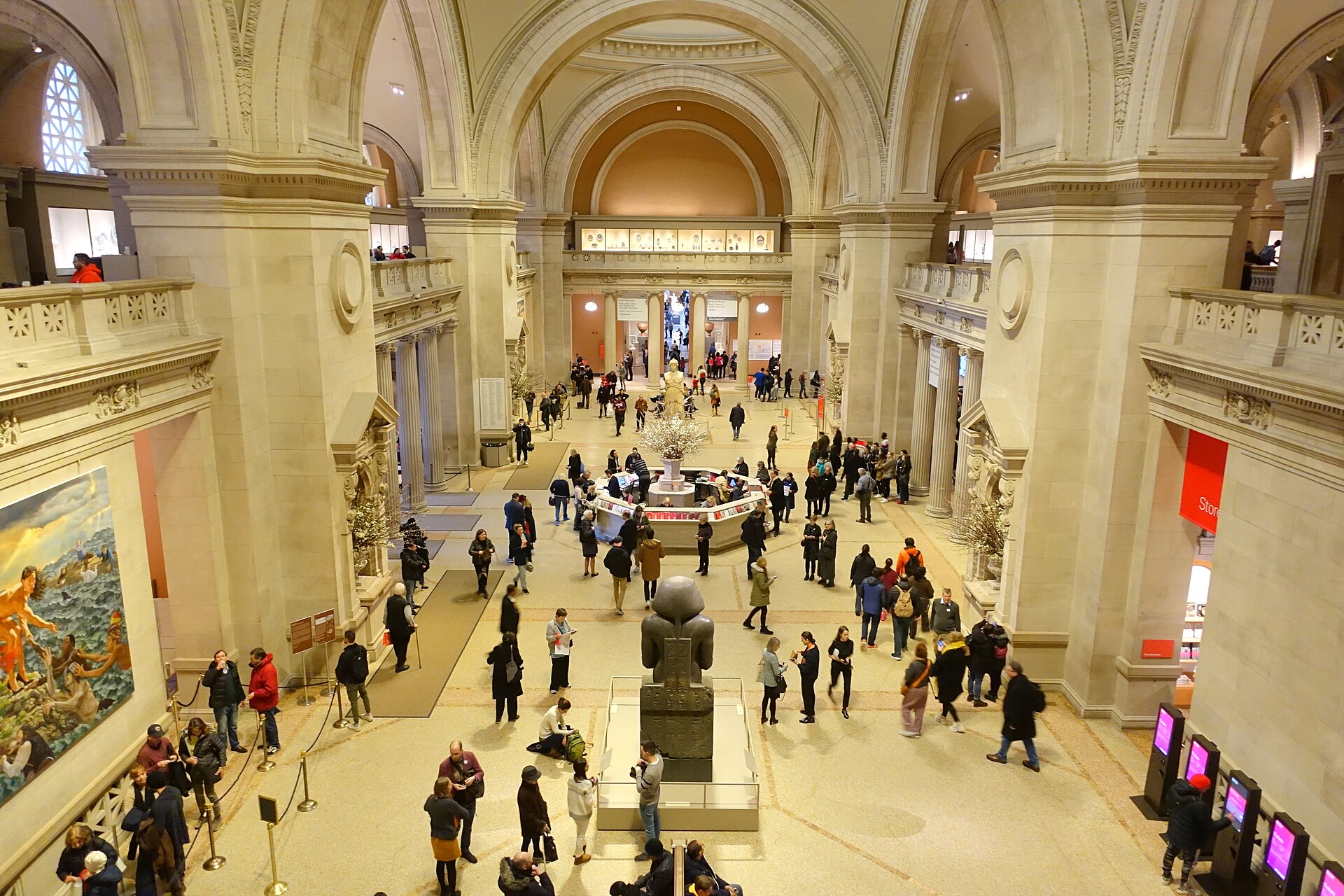
The Metropolitan Museum of Art’s Great Hall, photographed in February 2020. The Afrofuturist Period Room is not pictured.Daderot · CC0 · Cropped
Hyperallergic examines the Metropolitan Museum of Art’s Afrofuturist period room, which combines historical objects with contemporary work by Black artists and designers. The installation imagines descendants of Seneca Village’s displaced residents, bringing different eras into one domestic setting while reconsidering whose histories traditional museum rooms represent.
Anya Brilus’s ArtThrob review examines how Georgina Gratrix’s exhibition The Reunion at Norval Foundation expands portraiture beyond physical likeness. The Durban-raised artist’s layered paintings of her parents are set against Nine Weeks, a sequence of daily watercolour self-portraits made during South Africa’s 2020 lockdown. Brilus interprets the contrasting materials and repeated faces as records of relationships, memory and changing emotional experience.
Writing for ArtThrob, Francia Pratt considers how a pairing at Zeitz MOCAA connects memory with domestic life and material form. Her review brings Njideka Akunyili Crosby’s mixed-media painting Sunday Morning into conversation with Joël Andrianomearisoa’s fabric work. Pratt reads the photographic fragments and textile surfaces as different ways of holding personal histories, absence and bodily experience, showing how the exhibition’s paired presentation creates connections across distinct artistic practices.
Reviewing Brett Charles Seiler’s Closet at Goodman Gallery in Johannesburg, ArtThrob considered how paintings, text and an installation evoked queer intimacy, longing and religious exclusion. The critic recognised tenderness in the depicted relationships but questioned the exhibition’s nostalgic focus on familiar white gay cultural figures. The review argued that this framing left insufficient room for Black and brown queer histories and a broader understanding of community.