Gervais Marsh’s December 2022 Hyperallergic review examined the Kingston Biennial’s presentation of 24 Jamaican artists living locally and abroad. Under the theme Pressure, installations, painting and film addressed migration, spirituality and historical memory. Marsh highlighted exchanges between works by Kaleb D’Aguilar, Ricardo Edwards and Simon Benjamin while questioning the exhibition’s confinement to one floor of the National Gallery. The review preserved both the artistic range and curatorial tensions of the edition.
ArtReview reported Veronica Ryan’s 2022 Turner Prize win for her exhibition Along a Spectrum at Spike Island and her Hackney commission commemorating the Windrush generation. The public sculptures enlarged Caribbean fruits in marble and bronze, while the gallery work explored ordinary materials through careful acts of making. Ryan received the £25,000 award at a ceremony at St George’s Hall in Liverpool.
In her October 2022 Hyperallergic review, Catherine Yang considered Wangechi Mutu’s Storm King exhibition through its connections between women, mythology and the natural world. Bronze baskets containing tortoise shells, snakes or braided hair extended the artist’s hybrid visual language outdoors. Yang read the intertwined figures of In Two Canoe, also a functioning fountain, as an image of partnership and imagined ecological coexistence rather than a retreat from contemporary crises.
Dan Hicks’s June 2022 Hyperallergic report examined Hew Locke’s Foreign Exchange, an Ikon commission for Birmingham’s Commonwealth Games festival. Locke placed the city’s Queen Victoria statue aboard a fabricated ship alongside five smaller versions of the monarch. Rather than removing the monument, the intervention used added figures, crates and military imagery to examine, in Hicks’s reading, the circulation of imperial symbols. Hicks connected the work to Locke’s childhood encounters with another Victoria statue in Guyana.
Reviewing Simone Leigh’s Sovereignty for Hyperallergic in May 2022, Julie Baumgardner examined how the artist transformed the United States pavilion at Venice. A thatched exterior and monumental bronze and ceramic sculptures questioned colonial representation and national display. The review foregrounded Last Garment, a washerwoman derived from a Jamaican postcard, and Leigh’s stated commitment to Black women as an audience, presenting the pavilion as an argument for self-determination through sculpture.
In ArtReview’s April 2022 questionnaire, Sonia Boyce described her forthcoming British Pavilion as a space for improvisation, shared encounters and movement between different media. She resisted treating artistic traditions as neatly national and drew attention to generations of practitioners overlooked by international narratives. Boyce also identified Claudette Johnson’s work as an enduring influence, offering a direct account of the artistic relationships informing her Venice presentation.
Jasmine Liu reported for Hyperallergic in March 2022 that the Colby College Museum of Art had acquired Faith Ringgold’s Coming to Jones Road #4: Under A Blood Red Sky, made in 2000. Combining painted imagery and written narrative, the quilt follows people escaping enslavement through the Underground Railroad. The acquisition brought an important example of Ringgold’s storytelling practice into Colby’s collection,.
Kriston Capps’s January 2022 Hyperallergic review examined the Phillips Collection’s anniversary programme through Black abstraction. Retrospectives of Alma Thomas and David Driskell were accompanied by commissions involving Victor Ekpuk and Nekisha Durrett, and an installation by Sanford Biggers. Capps connected these presentations to Washington’s artistic histories, while asking whether this institutional attention would continue beyond a single celebratory season.
Hyperallergic·
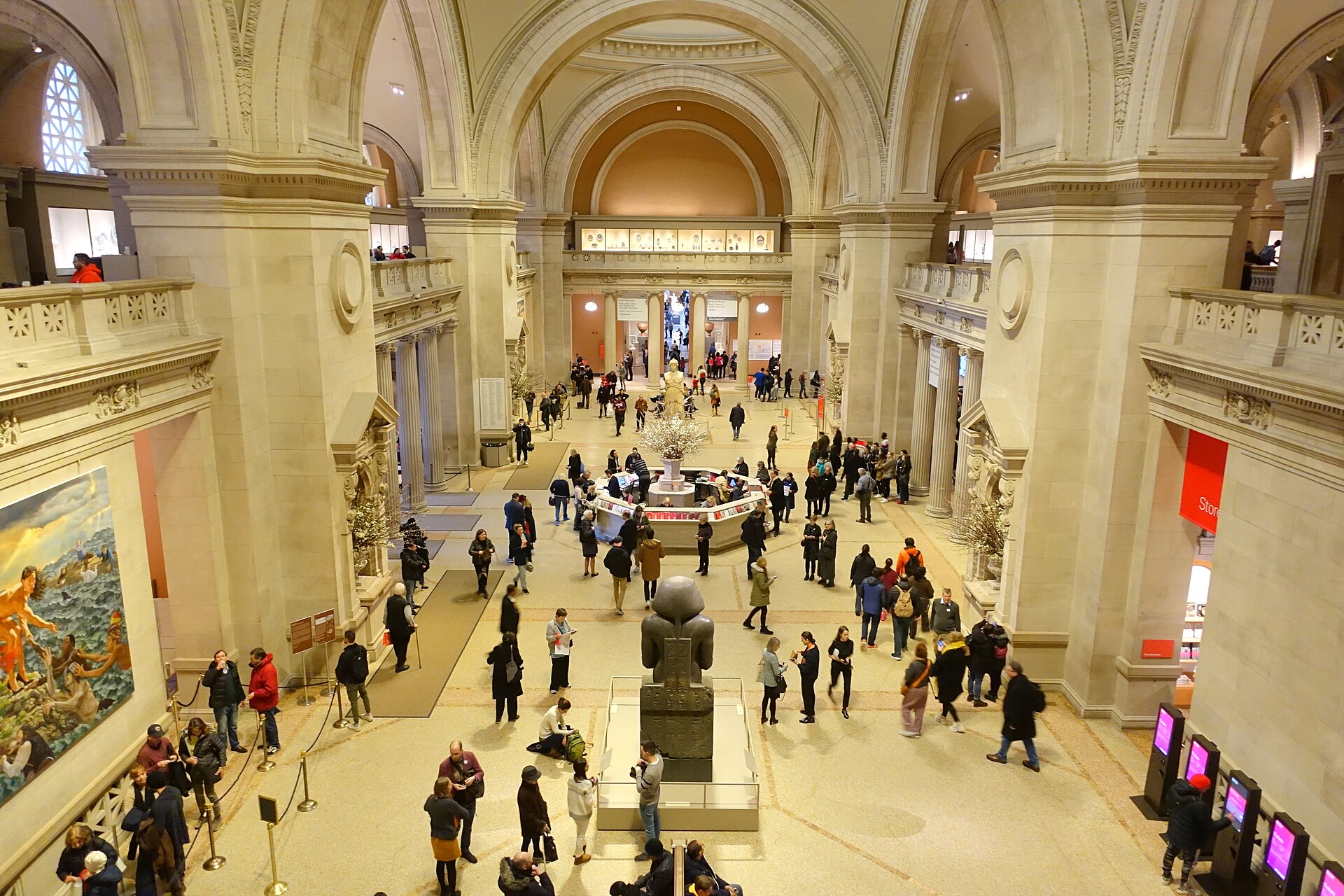
The Metropolitan Museum of Art’s Great Hall, photographed in February 2020. The Afrofuturist Period Room is not pictured.Daderot · CC0 · Cropped
Hyperallergic examines the Metropolitan Museum of Art’s Afrofuturist period room, which combines historical objects with contemporary work by Black artists and designers. The installation imagines descendants of Seneca Village’s displaced residents, bringing different eras into one domestic setting while reconsidering whose histories traditional museum rooms represent.
In a March 2020 ART AFRICA interview, Suzette Bell-Roberts spoke with AKKA Project founder Lidija Kostic Khachatourian about connecting African artists with audiences abroad and across the continent. Khachatourian discussed her galleries, collaboration on Mozambique’s 2019 Venice Biennale pavilion and the Art And About Africa platform. The interview records the platform’s intended role in mapping artists, spaces and events, rather than verifying its present-day services or later expansion plans.
ART AFRICA’s March 2020 feature examined the 21st Sesc_Videobrasil biennial in São Paulo, which included artists and collectives from Africa alongside other regions. Highlighting work by Emo de Medeiros, it described a programme concerned with marginalised communities and belonging beyond national identity. The feature also reproduced catalogue commentary by Sesc São Paulo director Danilo Santos de Miranda, making its institutional perspective explicit.
ART AFRICA reported FotoFest’s plans for African Cosmologies in March 2020. Curated by Mark Sealy, the Houston biennial’s central exhibition was announced as a focus on artists from Africa and its diaspora, accompanied by a book, films and public discussion. The announcement framed photography through cultural context, representation and human rights; its advertised dates should not be mistaken for confirmation that the full programme proceeded unchanged.
In a March 2020 ArtThrob review, Lucienne Bestall examined Kevin Beasley’s exhibition at A4 Arts Foundation following his Cape Town residency. She described sculptures made with found clothing, photographs and an audio installation assembled from city recordings. Her reading connected these materials with bodily absence, African-American cultural references and the movement of donated garments into South Africa’s informal economy.
ART AFRICA’s February 2020 announcement outlined a March Meeting programme connected to Okwui Enwezor’s conception of Sharjah Biennial 15. Proposed participants included Sammy Baloji, Otobong Nkanga and Chika Okeke-Agulu, with discussions examining exhibition-making and transnational exchange. The gathering was planned for 21–23 March, but Sharjah Art Foundation subsequently announced its indefinite postponement. The original article should therefore be read as a historical announcement, not confirmation that the event occurred.
ART AFRICA previewed the Virginia Museum of Fine Arts exhibition Working Together, devoted to Louis Draper and the Kamoinge Workshop. Drawing on photographs, archives and oral histories, it explored how the New York collective built opportunities for Black photographers through shared criticism, exhibitions and publishing. The 2020 presentation brought together more than 180 photographs by fifteen early members, alongside work to make Draper’s archive available digitally.
ART AFRICA·
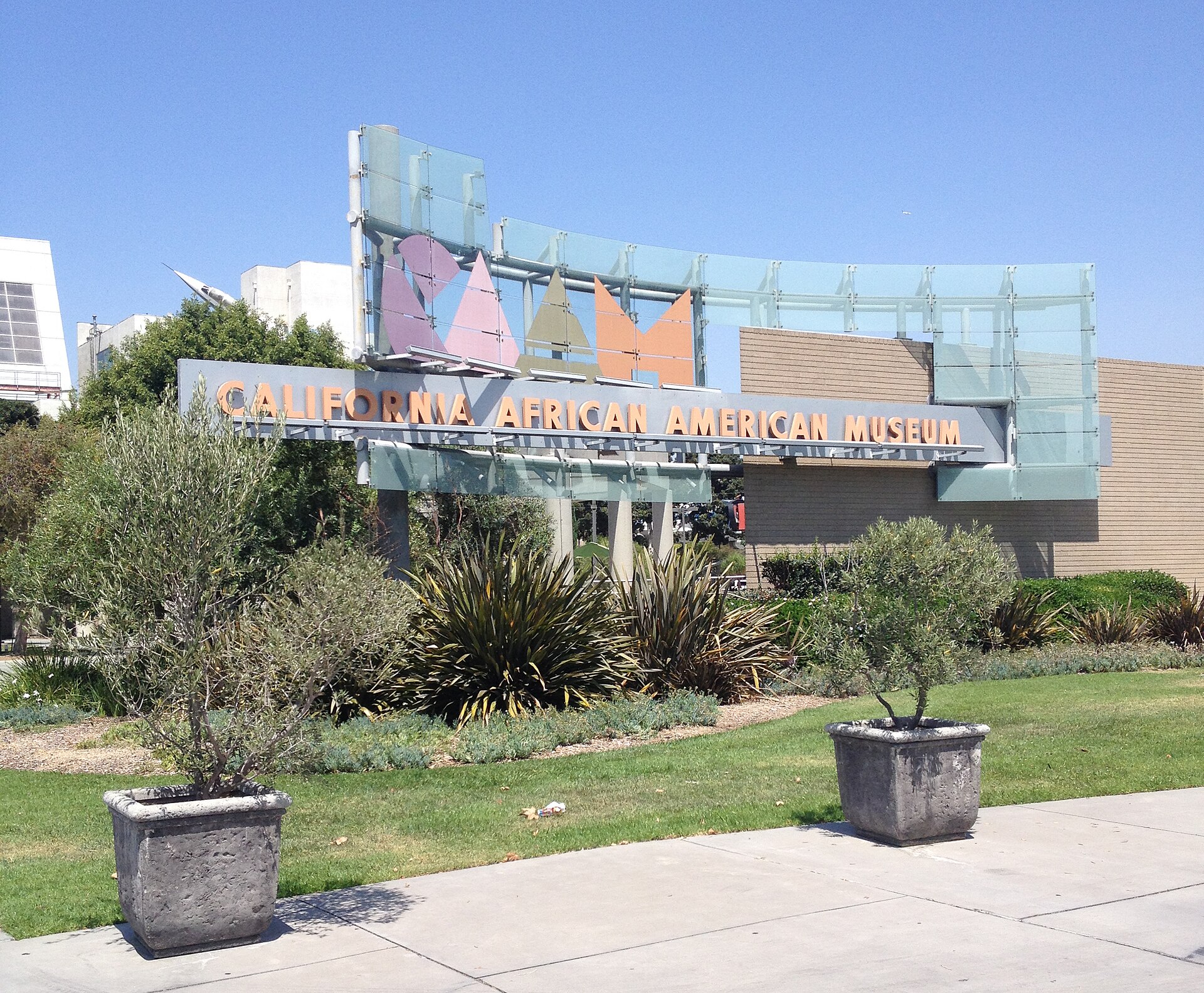
California African American Museum in Los Angeles, photographed on 18 August 2015 (file photograph). The museum hosted Making Mammy.Timtempleton · CC BY-SA 3.0
Writing about the California African American Museum’s Making Mammy exhibition, historian Brenda E. Stevenson examined how films, domestic objects and popular imagery distorted Black womanhood. The article traced the stereotype’s role in romanticizing slavery and obscuring violence, while emphasizing enslaved women’s agency and resistance. The exhibition situated these representations within the wider history of racism in American visual culture, rather than treating them as neutral historical illustrations.
Martin Herbert’s January 2020 ArtReview preview included substantial discussion of Kehinde Wiley’s engagement with European portrait traditions and Black representation. It also noted Ellen Gallagher’s Afrofuturist paintings within the announced Dhaka Art Summit programme. Read as an archival preview rather than current recommendations, the article records how these practices appeared within an international exhibition calendar at the beginning of 2020.
Laura Raicovich reflects on The NewOnes, will free Us, Wangechi Mutu’s four bronze figures installed in the Metropolitan Museum of Art’s façade. She reads their seated poses, coiled garments and reflective surfaces as a challenge to the building’s monumental authority and inherited European conventions. The essay connects the sculptures with questions of colonial history, Black presence and forms of beauty that dominant cultural narratives have excluded.
Jasmine Weber’s review of the 2019 1-54 Contemporary African Art Fair in New York follows connections between studio portraiture and newer photographic experiments. Works by Seydou Keïta, Malick Sidibé and J. D. ‘Okhai Ojeikere appear alongside artists including Hassan Hajjaj and Lebohang Kganye. Weber traces recurring concerns with beauty, family, identity and representation across African and diaspora practices, while highlighting photography’s exchanges with textiles, sculpture and collage.
In April 2019, ART AFRICA previewed Ghana Freedom, the country’s first national pavilion at the Venice Biennale. Curated by Nana Oforiatta Ayim within a space designed by David Adjaye, the announced exhibition would bring together El Anatsui, Ibrahim Mahama, Felicia Abban, Lynette Yiadom-Boakye, John Akomfrah and Selasi Awusi Sosu. Its planned installations, portraits and moving-image works addressed Ghanaian independence and its legacies across generations and diasporic experiences.